
From Coconut Husk to Compound: Turning Coconut Coir Fiber into an Injection-Moldable Material and Reducing Fossil-Plastic Content
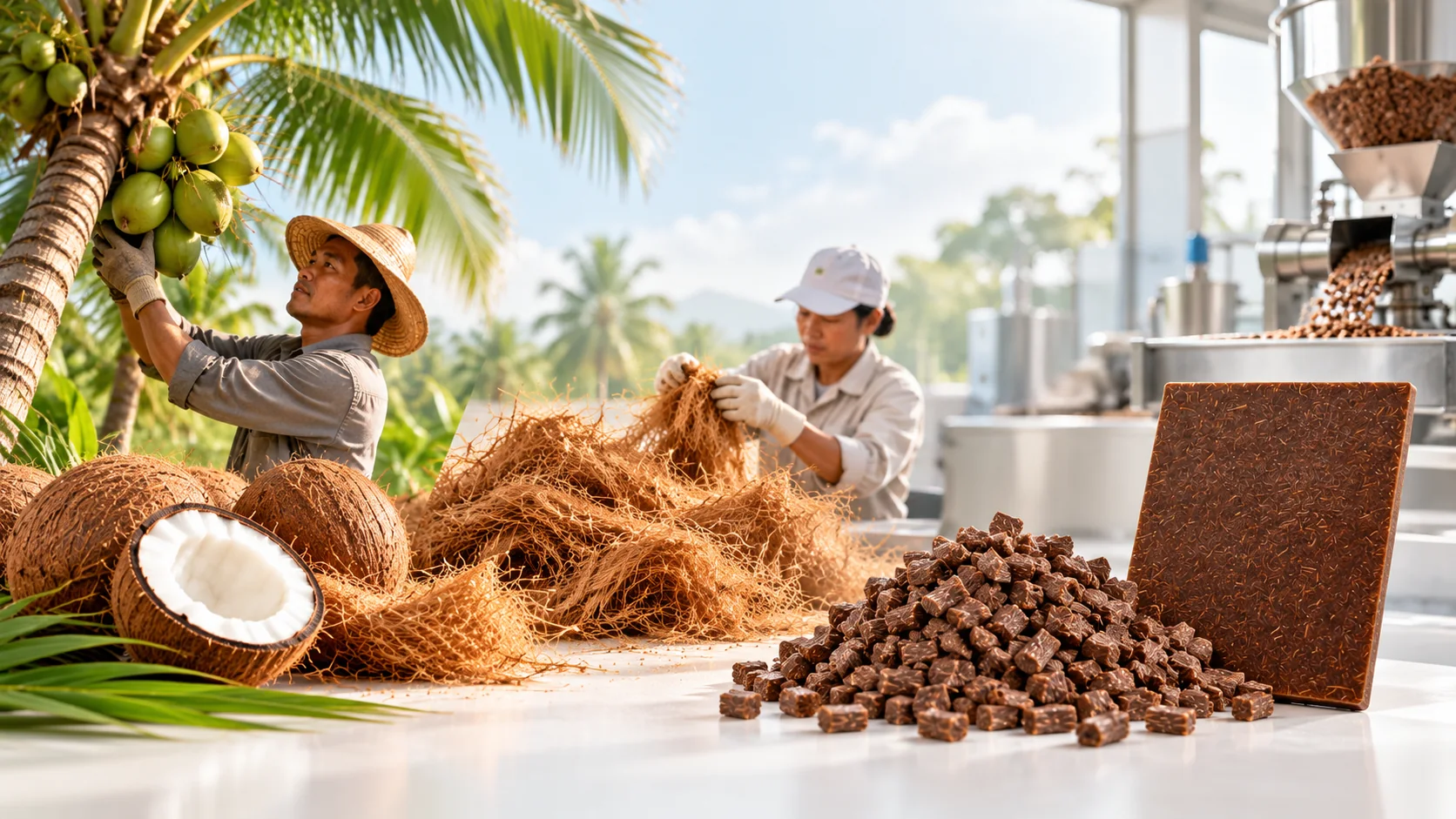
Coconut coir fiber is a special case among natural fibers: rich in lignin, corrosion- and moisture-resistant, and visually unmistakable. This is what it takes to turn it into pellets a factory can run.
Buyer and engineer FAQ
Questions about coconut coir fiber masterbatch and processing
Is coconut coir fiber composite a biodegradable material?
No. The PP or PE matrix is not itself degradable. Adding coir fiber reduces the petroleum-based share of the compound and introduces a recovered plant component, but the matrix still governs end-of-life behaviour. Claims about degradation belong to the specific finished formulation and the disposal environment it actually reaches.
Why is coir fiber stiffer than wood or straw fiber?
Because of lignin. Brown coir measures about 42.2% lignin and white coir about 40.8%, against roughly 25% to 35% for ordinary wood. Lignin is the component that carries rigidity and hydrophobicity, so a high lignin content gives coir fiber its natural stiffness and its resistance to moisture and corrosion.
Why does coir masterbatch need dilution rather than direct use?
YS60E carries 60% plant fiber and is a concentrated masterbatch, not a ready-to-mold compound. Supplying a fixed fiber content instead would lock in both stiffness and flow, forcing separate grades for stiff storage parts and thin-wall flow-critical parts. Diluting to ratio lets one masterbatch serve several final formulations — each of which then has to be validated on its own.
What causes warpage in coir fiber composites, and can it be controlled?
Warpage comes mainly from residual stress concentrated by fiber orientation, and it is process-dependent. Published optimization work on an automotive storage door reduced warpage from 1.609 mm by 58.02% and then by 70.23% through gate position, melt temperature, mold temperature and packing parameters. It can be controlled, but the parameters must be calibrated for the specific part and mold.
Does a plant-fiber compound corrode the mold?
Yes, ordinary steel tooling is at risk. At elevated temperature the fiber reacts with moisture to produce acidic species that attack the steel. Use stainless mold steel, or protect an ordinary mold by electroplating or chrome coating, and after production purge with PP or PE purging compound for 20 to 30 shots to remove the acidic residue from the mold surface.
Coconut coir fiber occupies a distinct place among natural fibers. It is not wood, not straw and not bamboo. It comes from the coconut husk — the thick outer shell of a palm — and it behaves differently from the fibers the plastics industry usually reaches for.
The scale of the resource is the first reason it attracts attention. Global coconut planting covers more than 12 million hectares and produces over 26 million tonnes of husk every year. More than 92% of that husk is not economically used; it is left to rot or is burned where it accumulates. Coir fiber itself is a much smaller stream — roughly 1.29 million tonnes a year worldwide — and most of it is exported as raw fiber. China imports about 65% to 70% of global coir fiber output.
At the same time, injection molders are looking for something specific: a natural fiber that is stiff enough, corrosion-resistant, moisture-tolerant and visually distinctive enough to work inside an engineering material. Coir fiber keeps being put forward because it offers a combination other fibers do not. But the path from husk to moldable pellet is long, and each step has to be solved.
1. Why Coconut Coir Fiber Is Worth Engineering
Coir fiber's chemistry differs fundamentally from wood and straw. Its lignin content is exceptionally high: brown coir measures about 42.2% lignin and white coir about 40.8%, against roughly 25% to 35% for ordinary wood. Lignin is the component of a natural fiber that carries rigidity and hydrophobicity. High lignin therefore means coir fiber is naturally stiffer than wood or straw fiber, and more resistant to corrosion and moisture.
Cellulose content is about 28.5% for brown coir, hemicellulose about 16.9%, and ash only 1.8%. Low ash matters in processing: it reduces the tendency to form ash residue and black specks. Coir fiber cells also have thicker walls than wood fiber, so the fiber is coarser — and a coarser fiber reinforces a matrix more efficiently per unit of loading.
Coir is corrosion-resistant in its own right. A coconut husk can hold its structure for years in coastal salt-spray conditions without rotting, which is the combined effect of lignin and waxes. That is why the traditional uses of coir worldwide are rope, matting, brushes and geotextiles — applications that all demand moisture and abrasion resistance.
Those same advantages carry a cost in an injection-molding context. A coarse fiber produces a coarse surface texture, which rules it out for pale, fine-appearance products. High lignin narrows the processing window, because lignin degrades at elevated temperature and generates odor and discoloration. And a coarse, stiff fiber is difficult to disperse in a screw and tends to agglomerate.
2. The Technical Gates Between Coir Fiber and a Usable Material
Gate one: fiber length and length-to-diameter ratio
Raw coir filaments run about 15 to 30 cm long, which makes direct injection molding impossible. The fiber has to be cut, milled and screened down into a length range suitable for injection. Published research shows the trade-off clearly: fibers that are too short concentrate stress at their ends, causing interfacial debonding and poor stress transfer between fiber and matrix, while fibers that are too long interact with each other and tend to bend or stand up. wooyopet controls the length-to-diameter ratio during fiber pretreatment to find the balance between reinforcement efficiency and dispersibility.
Gate two: interfacial compatibility
Coir fiber is polar and carries a large number of hydroxyl groups on its surface; PP and PE matrices are non-polar. Mixed directly, the interface bonds poorly and the fiber sits in the matrix much like sand stirred into glue — it neither anchors nor transfers load. Maleic anhydride grafted polypropylene (PP-g-MAH) is the industry's usual compatibilizer and improves how the fiber is wetted by the molten polymer. Research also indicates a limit to what PP-g-MAH achieves with coir: substantial chemical interaction between PP and coir fiber is unlikely, and the gain is mostly improved physical wetting. wooyopet combines a compatibilizer system with fiber surface treatment to balance physical wetting against chemical bonding.
Gate three: dispersion uniformity
Coir fiber agglomerates readily in a PP matrix. Once fibers cluster, the inside of the agglomerate is fiber touching fiber while only its outside contacts the PP, and the molded part shows local color variation and coarse points on the surface. wooyopet controls the dispersion state during pelletizing through screw configuration and compounding practice, so that the highly filled masterbatch can be diluted to ratio by the customer and fed straight to an injection machine.
Gate four: drying
Coir fiber is less hygroscopic than wood fiber because its lignin and waxes are more hydrophobic, but drying is still mandatory. The drying window for coir masterbatch is 80 to 100°C for three to four hours. If drying is insufficient, moisture vaporizes during injection and produces bubbles and flow marks on the part surface.
3. What to Expect on the Injection-Molding Floor
Coir fiber composites share some problems with wood and bamboo fiber composites, and have their own as well.
Warpage. Coir husk fiber composites are prone to warpage in injection molding because fiber orientation concentrates residual stress. Published work has optimized coir composite injection parameters using orthogonal experiments and a BP neural network. Taking an automotive passenger-side storage door as the case, optimizing gate position, melt temperature, mold temperature and packing parameters reduced warpage from 1.609 mm by 58.02%, and further optimization reduced it by 70.23%. This shows coir composite warpage can be controlled through process optimization — but the parameters have to be calibrated for the specific part and mold.
Surface coarseness and color variation. Coir fiber particles are coarser than cereal and wood fiber, so the molded surface shows more pronounced grain. Where a brand accepts a coarse natural texture this is a selling point; where a fine surface is required, the dilution ratio must be raised or a finer fiber mesh selected.
Odor. Coir's own odor is very faint, and after molding there is essentially no noticeable fiber odor. This is an advantage over tea fiber and coffee grounds: for applications where odor must not become a product characteristic, coir is the safer choice.
Injection temperature window. The recommended injection temperature for coir masterbatch (YS60E) is 160 to 190°C. To keep the plant fiber structure intact, the injection process temperature is best held below 190°C, in the 180 to 190°C band. Residence time in the barrel should not be long. Coir lignin degrades at high temperature and produces odor and discoloration, but compared with wood fiber its carbonization point is slightly higher and the processing window a little wider.
Mold corrosion. Like every plant-fiber composite, coir fiber reacts with moisture at high temperature to produce acidic species that corrode ordinary steel tooling. Stainless mold steel is recommended, or electroplating or chrome coating on an ordinary mold. After production, purge the mold with PP or PE purging compound for 20 to 30 shots to carry the acidic species off the mold surface.
4. wooyopet's Coconut Coir Fiber Materials
wooyopet offers two core products on its coir fiber line.
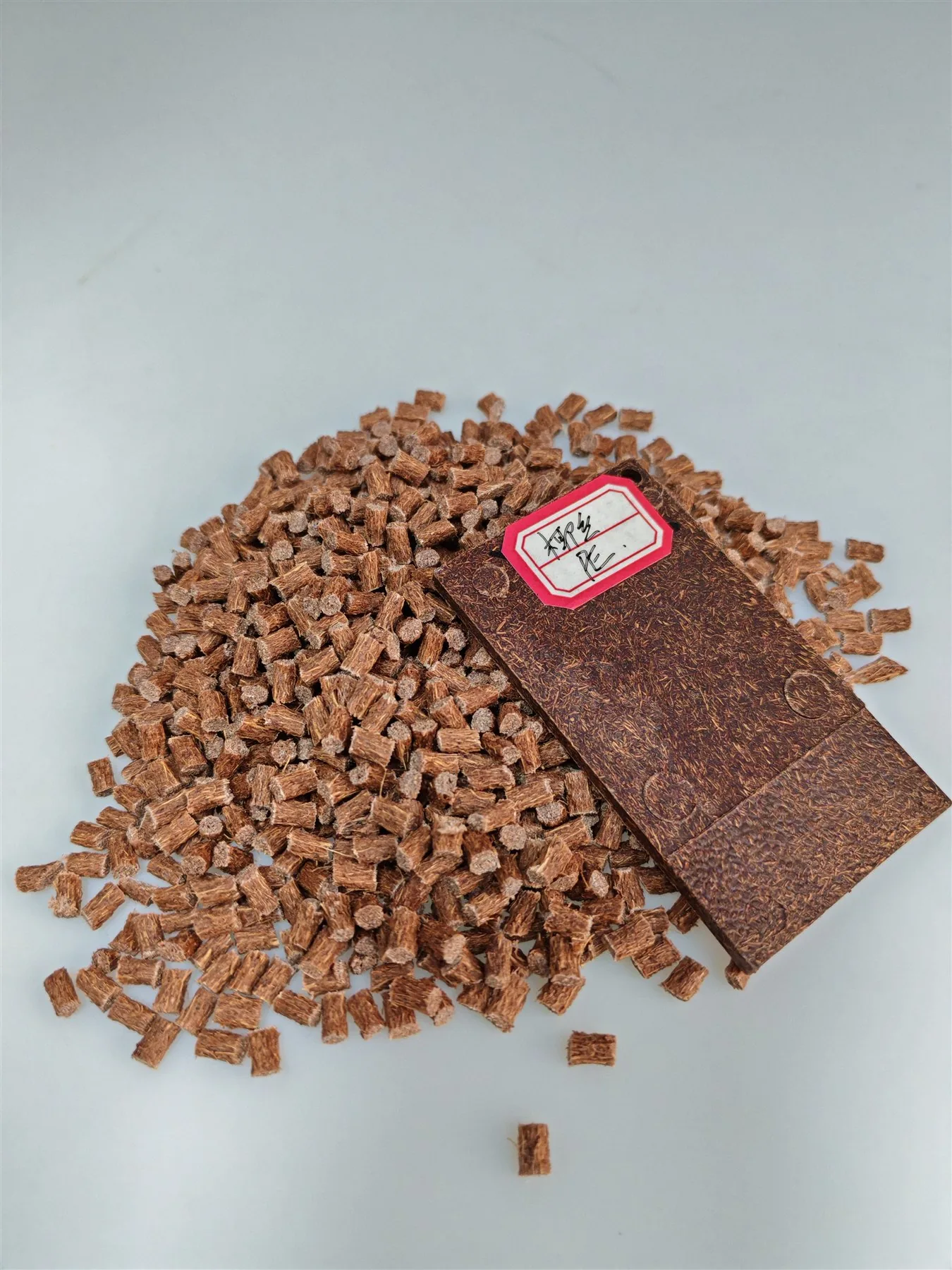
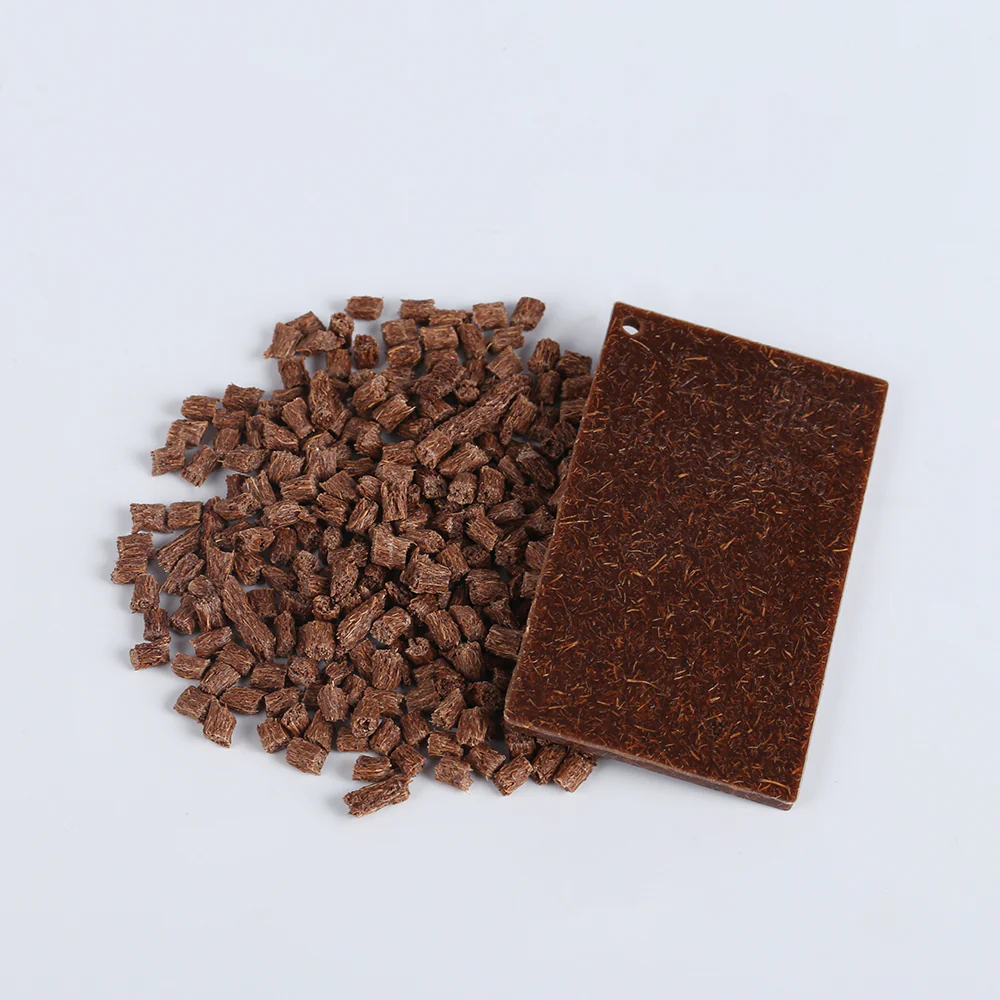
WYC-PE YS60E (coconut coir fiber PE masterbatch). Plant fiber content 60%, dark brown pellets, supplied in masterbatch form. Property data: tensile modulus 40 MPa, elongation at break 4.8%, elastic modulus 1,300 MPa, flexural strength 82 MPa, flexural modulus 4,400 MPa, notched Izod impact 3.9 kJ/m² at 23°C, density 1.17 g/cm³, melt index 3.18, hardness 82.
At 4,400 MPa, the flexural modulus of YS60E sits at the high end of wooyopet's plant-fiber masterbatch range. That number still delivers substantial stiffness reinforcement after dilution. Diluted 1:3 with conventional PE, the final fiber content is about 15% and flexural modulus falls in the 1,500 to 2,000 MPa band — suitable for injection-molded storage boxes, trays and structural parts that need stiffness. A melt index of 3.18 is low, so injection requires higher injection pressure and finer temperature control.
The deep brown of YS60E lightens to pale brown or beige-brown after dilution, and the part shows a natural coir texture. The fiber forms elongated streaks in the matrix, giving the highest visual distinctiveness of any wooyopet plant-fiber material.
WYC-PP P179-YSML (coconut coir fiber PP masterbatch). Supplied in the same highly filled masterbatch form for downstream factories to dilute to ratio with conventional PP. The PP matrix has a different processing temperature window and injection parameters from PE, and suits applications that need PP matrix performance.
The shared logic of both products is to make coir fiber into a high-concentration masterbatch and let the downstream factory dilute as needed. Supplying ready-to-use pellets with a fixed fiber content instead would lock in stiffness and flow: a storage box needing high stiffness and a thin-wall part needing high flow would require different grades, multiplying stock items and changeover cost. The masterbatch model lets a factory adjust fiber content for the specific product, which changes formulation flexibility entirely.
5. What Coconut Coir Fiber Materials Are Good For
Stationery, gifts and home objects. Coir's elongated texture and deep brown tone are a natural visual signature. Pen holders, planters, storage baskets, picture frames and decorative trays made from it are immediately recognizable as a natural material. Cereal and bamboo fiber cannot match that recognition — they are too fine and do not read as "natural" enough.
Pet products (non-chew). Clips on pet houses, food bowl bases, cat tree fittings and leash connectors all need stiffness, and coir's high flexural modulus meets that need. Its coarse surface and deep brown do, however, limit use in pet chew sticks: a chew stick needs a fine bite feel and a natural pine scent, which wood-fiber PP suits better.
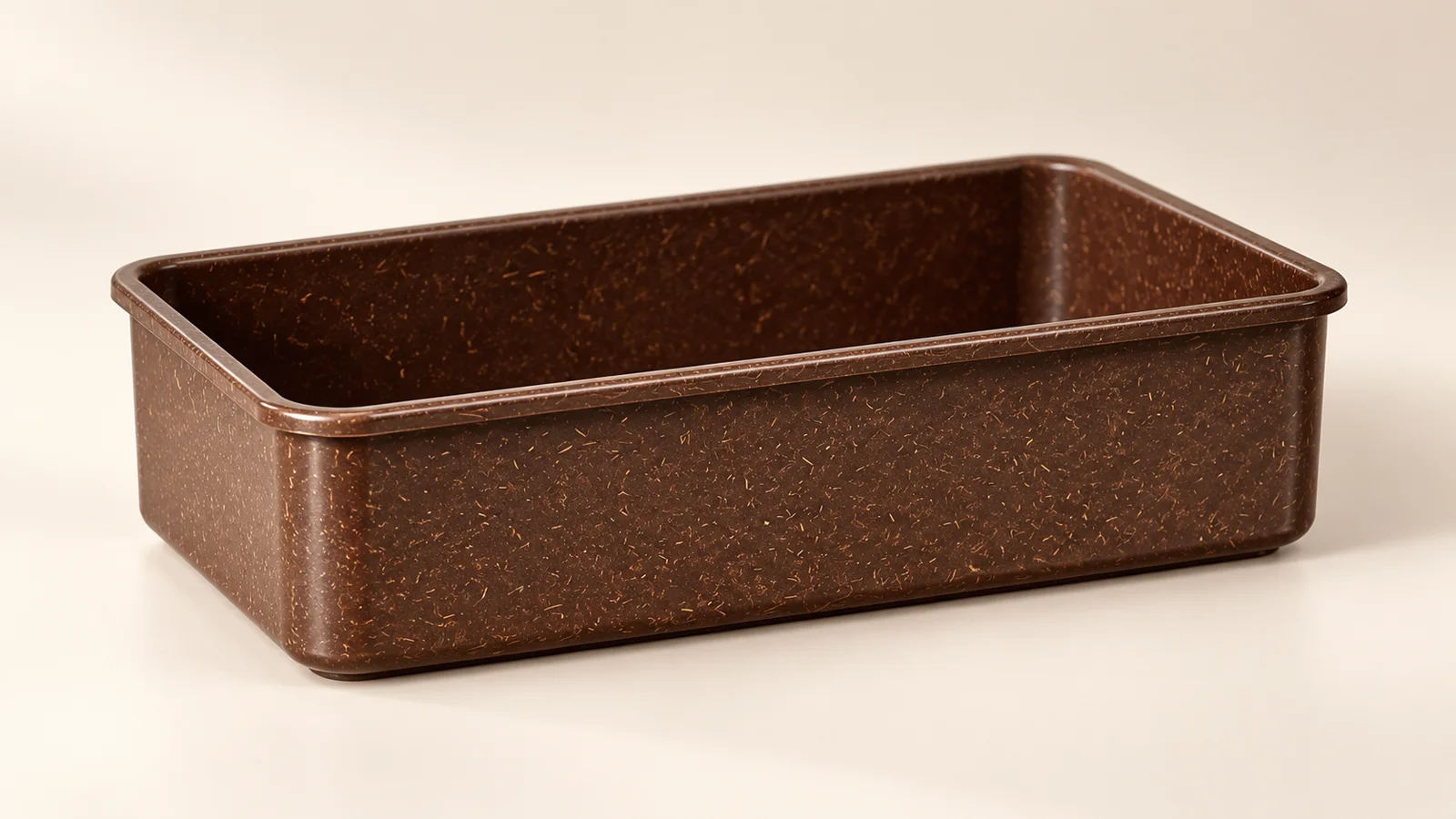
Storage boxes and trays. Storage items that need high stiffness can be met by diluting coir masterbatch and injection molding it to reach adequate flexural modulus. The deep brown or beige-brown tone suits products that do not want an added color masterbatch. Shrinkage and warpage, however, must be process-optimized for the specific mold; parameters for pure PE or pure PP cannot simply be copied across.
Where coir fiber does not fit. Pale products, food-contact appearance parts, applications with strict odor requirements, and thin-wall precision parts. Coir's color and particle size mean it has no advantage in those situations.
6. From Husk to Material: the Resource Argument
The world produces 26 million tonnes of coconut husk a year, and more than 92% of it is not economically used. That husk is left to rot or burned at source, releasing methane and particulate matter. Turning it into an injection-molding material that replaces part of the petroleum-based plastic content does two things at once: it reduces the agricultural waste that has to be dealt with, and it lowers the fossil share of the finished part.
From a life-cycle perspective, research on coir geotextiles reports a 34% to 40% reduction in global warming potential for coir products compared with synthetic alternatives, attributed mainly to the biodegradability of coir fiber. A thousand coir bio-trays can store up to 34 tonnes of carbon while reducing transport cost and limiting deforestation.
wooyopet's coir fiber materials are not "degradable materials". PP and PE matrices are not themselves degradable; adding coir fiber reduces the petroleum-based share. But the husk would otherwise have been discarded or burned. Made into storage boxes, planters and pet products, it displaces petroleum-based plastic over the product's service life, and at end of life the coir fraction can biodegrade if it reaches a suitable environment.
Turning a wasted resource into an injection-moldable engineering material does not need to be overstated. Coir fiber's stiffness, corrosion resistance and visual distinctiveness are its real value at the material level. What wooyopet does is extract that value out of the "husk" form and deliver it as pellets a molder can feed directly. The downstream factory does not handle husk, does not mill fiber and does not solve dispersion — it dilutes to ratio and injects to parameters.
7. Selecting Between the Two Coir Routes
| Requirement | Preferred Route | Why | Still to Validate |
|---|---|---|---|
| High stiffness with a PE matrix | YS60E diluted with conventional PE | 4,400 MPa flexural modulus in masterbatch form, about 15% fiber in a 1:3 blend | Final blend flow, warpage, shrinkage and color at the actual dilution |
| PP matrix performance | P179-YSML diluted with conventional PP | Keeps the PP matrix while adding coir reinforcement | Let-down ratio, melt index of the final blend, impact and surface |
| Strong natural visual identity | Either coir route | Elongated fiber streaks and a deep brown natural tone | Approved molded plaque, color variation between lots |
| Pale or fine-appearance parts | Cereal, bamboo or fine wood fiber instead | Coir particle size and color work against a fine pale surface | Whether a finer mesh or higher dilution can reach the target appearance |
| Odor-sensitive products | Coir is the safer choice among plant fibers | Coir odor is faint and largely absent after molding | Confirm on the actual formulation and process window |
The two coir masterbatches differ in matrix, not in concept. Selecting between them should follow the base-resin performance the finished part needs, then the dilution ratio, then the appearance approval. Neither route removes the need to calibrate drying, temperature window, packing and mold protection for the specific tool.
Contact
Turn the trial settings into a documented process window
Share your material, part and mold information for grade selection, sampling and production troubleshooting.
- Email: info@wooyopet.com
- WeChat: mkx13905842100
- WhatsApp (DEYU General Reception): +86 13905842100+86 15325909695