
Food-Grade Plant-Fiber Composite Plastics: A Practical Compliance Guide for Buyers
A supplier's pellet report is only one piece of the evidence. The finished formulation, conversion process, intended food, temperature, contact time and destination market determine whether the final article is compliant.

Buyer and compliance FAQ
Questions to resolve before calling a plant-fiber plastic “food grade”
Is an FDA test report the same as FDA approval or certification?
No. FDA does not issue a general “food-grade certificate” for a finished plant-fiber container. Each substance and use must be covered by an applicable regulation, effective Food Contact Notification or other authorization, and the finished article must be manufactured for the intended conditions of use. A laboratory report can support the compliance file, but it does not replace the legal review.
Does an LFGB report automatically cover the United States?
No. “LFGB testing” is common commercial shorthand for a German-market test package, but German and EU rules do not substitute for the US framework. Likewise, a US-oriented report does not establish EU or German compliance. Test the finished formulation against the requirements and use conditions of every destination market.
If the pellets pass migration testing, will the molded article pass?
Not necessarily. The converter can introduce a different dilution resin, color masterbatch, additive, regrind, contaminant or thermal history. Part thickness, surface area, food simulant, contact time and temperature also change the test exposure. The final article or a justified worst-case specimen must represent the marketed formulation and use.
Is there a universally safe percentage of recycled PP for food contact?
No. A percentage such as 20% or 30% is not a universal safety threshold. Compliance depends on the source stream, previous use, collection controls, decontamination process, traceability, destination-market rules and intended food-contact conditions. Unverified general-purpose regrind should not be treated as food-contact compliant simply because its proportion is low.
What information should be given to the testing laboratory?
Provide the complete formulation, intended food types, maximum temperature, contact time, single-use or repeat-use status, surface-area-to-volume relationship, destination market and any special consumer group. Without those inputs, a passing test may cover the wrong simulant or exposure condition.
Treat the supplier report as the beginning of the compliance file. Define the complete formulation, processing controls, intended contact conditions and destination market before testing the finished article.
One of the most expensive mistakes in plant-fiber composite purchasing begins with a simple document: the supplier sends an FDA- or LFGB-oriented report for a pellet sample, and the buyer assumes the material can now be molded into any food-contact product. That conclusion skips the most important part of compliance—the article that will actually touch food.
A plant-fiber PP compound is not only polypropylene plus a natural filler. Its compliance profile also includes the fiber treatment, compatibilizer, stabilizer, colorant, processing aid, dilution resin and every substance created or introduced during conversion. The relevant legal route changes again when the product moves from China to the United States, the European Union or Germany. The safest purchasing method is therefore to build a traceable chain from each input to the final formulation and then validate the finished article under its real conditions of use.
1. “Food Grade” Is a Claim, Not a Universal Material Category
The phrase “food grade” is useful in commercial conversations, but it is not a single international approval. A material can be suitable for room-temperature contact with dry food and unsuitable for hot oil, acidic food or repeated dishwasher use. Compliance attaches to a defined composition, intended use and jurisdiction.
Start every project with a written use specification. Identify whether the article is a spoon, bowl, lid, cup, storage container or packaging insert; whether it contacts aqueous, acidic, alcoholic, fatty or dry food; the maximum filling and storage temperatures; contact duration; and whether the article is single-use or reusable. Testing without that specification can generate a technically valid report that does not cover the marketed product.
2. FDA, EU, German and Chinese Requirements Are Different Routes
In the United States, a buyer should not ask whether the product has an “FDA certificate.” The correct question is whether every food-contact substance in the formulation is authorized for the intended use. Polypropylene may fall within 21 CFR 177.1520 when its identity, specifications and conditions are met, while additives, colorants, adhesives and other components need their own applicable legal basis. A laboratory migration study may support the safety and exposure assessment, but it is not a blanket FDA approval.
For the European Union, Regulation (EC) No 1935/2004 supplies the general safety framework, and plastic materials are subject to Regulation (EU) No 10/2011. The plastic rules address authorized substances, specific restrictions, overall and specific migration, testing conditions, declarations of compliance and supporting documentation. Germany applies that EU framework together with national law, including the LFGB. Commercial “LFGB testing” often includes sensory evaluation because food-contact articles must not unacceptably change a food's odor, taste or other organoleptic properties. It should not be treated as a universal certificate or as evidence for the US market.
For China, GB 4806.7-2023 covers food-contact plastic materials and articles, including pellets and masterbatches as well as finished plastic products. Additives must be reviewed under GB 9685 and related announcements, while migration testing and labeling must match the applicable GB 4806 framework. A report on a masterbatch therefore documents that tested material and its stated scope; it does not automatically cover a customer's modified blend.
| Market | Primary Compliance Question | Evidence a Buyer Should Request |
|---|---|---|
| United States | Are all substances authorized for the intended food type, temperature and use? | Regulatory status of resin and additives, formulation disclosure at the necessary level, applicable use limitations and supporting migration or exposure data |
| European Union | Does the final plastic article meet the framework and plastics-specific rules? | Declaration of Compliance, supporting documentation, overall and specific migration results, NIAS risk assessment and intended-use conditions |
| Germany | Does the article meet EU requirements and applicable German provisions without impairing food? | EU compliance package plus sensory or other German-market testing justified by the material and application |
| China | Does the material and finished article meet the applicable GB 4806 route? | Current material report, additive compliance information, finished-article test plan and results under the declared use conditions |
3. A Pellet Report Is the Beginning of the Compliance File
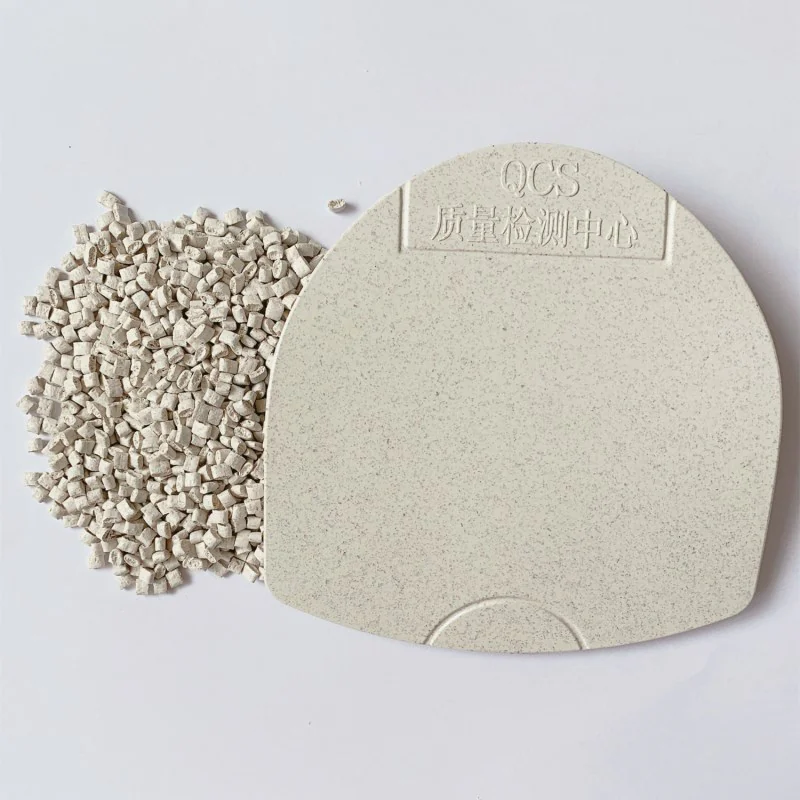
A pellet, masterbatch and finished article are different test objects. A ready-to-mold compound may already contain its intended fiber percentage. A concentrated masterbatch must be diluted with a specified compatible resin. Once a converter changes that ratio, adds pigment or regrind, or uses a different base resin, the marketed formulation is no longer identical to the supplier's laboratory specimen.
Read the report scope line by line. Confirm the exact grade and batch, sample description, plant-fiber loading, base resin, color, test standard, food simulants, contact time, temperature, surface-area assumptions and test date. Check whether the report covers a raw material, a plaque, a finished container or a specific article. If the report describes pellets but the sales claim concerns a reusable hot-food bowl, a documented bridge between those two objects is still required.
4. Five Downstream Variables Can Change the Result
Dilution resin
The virgin PP used to dilute a high-fiber masterbatch needs its own food-contact status for the destination market and intended conditions. “PP” alone is not enough: the exact resin grade, additives, comonomer content and use limitations matter. Mixing a compliant masterbatch with undocumented general-purpose PP breaks the traceability chain.
Recycled resin and regrind
There is no general 20% or 30% rule that makes recycled PP acceptable for food contact. Post-industrial regrind from the same controlled food-contact production may present a different risk from mixed post-consumer PP, but either route needs documented control. In the EU, recycled plastics for food contact are governed by Regulation (EU) 2022/1616 and its technology, process, input, traceability and use requirements. In the United States, the source, recycling process and intended use likewise determine the supporting safety position. Unknown regrind can carry inks, adhesives, cleaners, degradation products or contaminants from previous service.
Colorants and other additives
A compliant natural-color compound can become non-compliant after the converter adds an unsuitable color masterbatch, slip agent, fragrance, antistatic agent or mold-release additive. Each substance must have an applicable legal basis and must remain within any restriction. Dark tea- or coffee-colored grades may reduce the need for added pigment, but their natural color does not remove the need to review the full formulation.
Plant-fiber variability and NIAS
Natural feedstocks vary by species, origin, harvest, cleaning and storage. They may contribute odor-active compounds, background metals, residues or other constituents. Processing can also form non-intentionally added substances, including reaction and degradation products. NIAS are not managed by checking a short positive list alone; the producer and converter need a risk assessment based on the real formulation and process.
Thermal history
Excessive melt temperature, shear, hot-runner residence or repeated reprocessing can darken plant fibers and increase odor or degradation products. There is no universal 180°C warning point or 220°C carbonization point for every cereal, bamboo, wood, tea and coffee formulation. Use the exact grade's processing window, minimize residence time and investigate any burnt odor, black specks or unexpected color shift before releasing food-contact production.
| Variable Added After the Supplier | Possible Compliance Effect | Control |
|---|---|---|
| Dilution PP | Introduces a different additive package or use limitation | Record exact virgin-resin grade and regulatory basis |
| Recycled PP or regrind | Introduces unknown contaminants or additional thermal history | Use only a documented, market-appropriate controlled route |
| Color masterbatch | Adds pigments, carriers and potential restricted substances | Approve colorant documentation and test the final color |
| Process aid or release agent | Changes the final formulation and migration profile | List every addition and review its intended-use authorization |
| High temperature or long residence | Can form odor-active or other degradation products | Control actual melt temperature, residence time and shutdown |
5. BPA and Metals Must Be Evaluated by the Applicable Rule
Cross-market comparison tables can be misleading when they place a general heavy-metals result beside a substance-specific migration limit from another regulation. Lead, cadmium, antimony, primary aromatic amines and other analytes can be governed by different material categories, positive-list entries, pigment rules or test conditions. A buyer should build the test list from the complete formulation and the applicable legislation, not from a generic “China versus EU” chart.
The EU has tightened its approach to bisphenols through Regulation (EU) 2024/3190. For compliance verification, the regulation specifies a method detection limit of 1 μg/kg unless a different limit applies under the regulation or the recommended method. That analytical requirement should not be rewritten as one universal migration limit for every substance and every article. Transitional provisions and narrowly defined derogations also need to be checked against the exact application.
Plant fibers deserve incoming control because agricultural feedstocks can carry variable background constituents from soil, water and processing. But fiber origin alone does not predict a migration failure. The practical response is supplier qualification, lot traceability, risk-based screening and finished-article testing—not a claim that every natural fiber is either automatically safe or automatically contaminated.
6. Case Study: What a Hotel Toothbrush Trial Can—and Cannot—Prove
A wooyopet customer developed a disposable hotel toothbrush handle using WYC-PP P179002N cereal-fiber PP. The first formulation diluted the compound with recycled PP and targeted roughly 20% plant-fiber content in the molded handle. Appearance was acceptable, with a consistent matte surface and visible cereal speckles, but the customer's voluntary laboratory screening reported an overall-migration result outside the selected test criterion and a slight sensory odor.
The investigation identified multiple uncontrolled variables rather than assigning the result to the supplied compound alone. The recycled PP source was not sufficiently stable, drying had not been maintained for the full production run, and the final blend differed from the supplier's reference sample. Unknown residues, moisture, thermal history and the higher exposed plant fraction all had to be considered.
The revised trial used a documented virgin PP dilution grade, removed general-purpose recycled resin, reduced the final plant-fiber content to approximately 10% and used controlled dehumidifying drying for 4.5 hours. The customer then remolded the handle and repeated its specified migration and sensory screen. The revised sample met those selected laboratory criteria and retained a fine natural matte texture.
A toothbrush is not a food-contact article, so this result must not be advertised as universal FDA, LFGB, EU 10/2011 or GB 4806 approval. The value of the case is process discipline: changing the dilution resin, fiber level and drying changed the test outcome. The commercial description should remain accurate—plant-fiber PP handle, reduced fossil-resin share and natural cereal texture—while oral-contact and consumer-product requirements are reviewed separately for the destination market.

7. Build a Finished-Article Validation Plan
The laboratory needs enough information to select the correct simulants and exposure. State the food types, maximum contact temperature, duration, filling method, storage, repeated-use cycles and surface-area-to-volume relationship. If multiple colors or formulations share one product family, document why a selected sample is the worst case. A dark color is not automatically the worst case, and the highest fiber loading may not cover a different additive package.
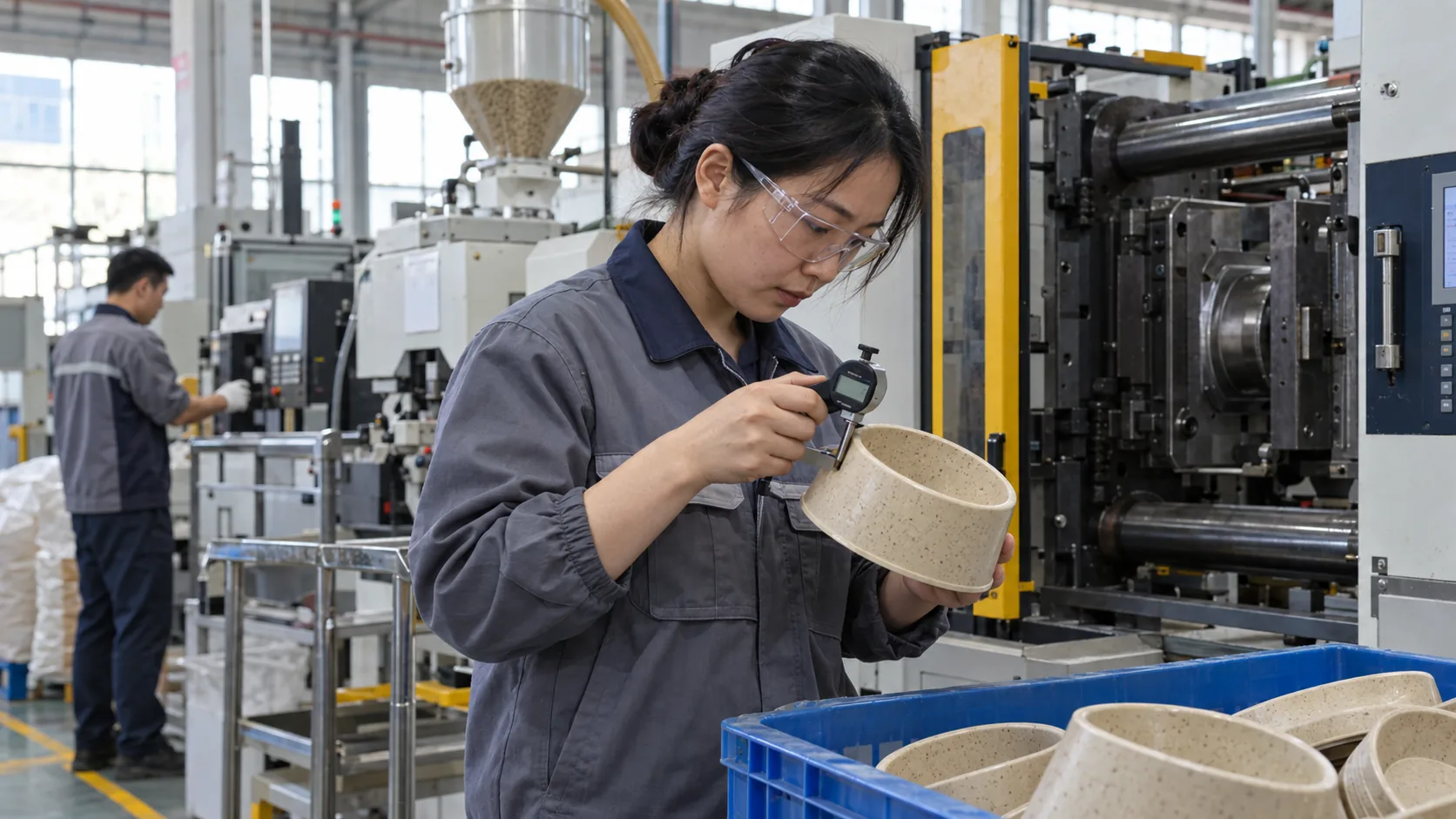
Keep production records with the test file. The approved bill of materials, resin and colorant batch codes, drying log, barrel settings, actual melt-temperature check, regrind policy and retained finished parts establish that the tested article matches commercial production. Retest after a formulation, supplier, colorant, fiber source, recycling route, process window or intended-use change that could affect migration or sensory performance.
| Validation Stage | Required Record | Release Question |
|---|---|---|
| Regulatory mapping | Destination markets, article type and intended conditions of use | Which laws and test conditions apply? |
| Input approval | Exact compound, dilution resin, colorant, additives and recycled-content route | Is every component documented for this use? |
| Formula lock | Bill of materials with plant-fiber and masterbatch ratios | Does production match the tested blend? |
| Process lock | Drying, melt temperature, residence time, regrind and cleaning records | Could processing create or introduce new migrants? |
| Finished-article testing | Representative or justified worst-case samples with use conditions | Do migration, sensory and other required results pass? |
| Change control | Supplier, batch, formulation, color and process-change review | Does the change require additional assessment or retesting? |
8. Procurement Checklist
Before placing an order, request the current report for the exact grade and confirm whether it covers pellets, a masterbatch, a plaque or a finished article. Ask for the formulation information needed to evaluate authorized substances and restrictions, while respecting the supplier's confidential information process. Record the intended dilution resin and prohibit undocumented substitutions.
Do not approve recycled PP by percentage alone. Verify the source, collection or closed-loop controls, decontamination or recycling route, traceability and destination-market status. Obtain separate compliance evidence for color masterbatch and every processing additive. Run the molding trial within the grade-specific thermal window, retain samples and inspect odor, color and deposits as process indicators.
Finally, send the finished article—or a technically justified worst-case specimen—to a competent laboratory with the actual use conditions. Review the report scope before using any “food grade,” FDA, LFGB, EU or GB 4806 statement in sales material. Repeat the review whenever the formulation or process changes.
The central lesson is simple: a compliant pellet can be one component of a compliant food-contact article, but it cannot certify the converter's final product. Buyers reduce risk by treating compliance as a controlled chain of formulation, manufacturing, testing, documentation and change management.