
Fully Biodegradable Materials Are Not Necessarily Safer: Performance, Mineral Fillers, and Food-Contact Safety—What Really Determines Usability?
Biodegradability, real-world performance, and food-contact safety are separate questions. This guide explains what actually determines whether a sustainable plastic can work in production and in use.
Buyer and engineer FAQ
Questions to ask before selecting a biodegradable food-contact plastic
Does “fully biodegradable” mean a material will work in the finished product?
No. PLA can begin softening around 55–60°C, has only about 2%–6% elongation at break and requires a tightly controlled processing window. It may satisfy an industrial-composting claim yet still fail the product’s heat, impact, dimensional or service-life requirements.
Why can mineral-filled PLA or PBAT be risky for acidic food contact?
Mineral filler can improve stiffness, crystallization and cost, but migration must be tested separately. The article cites PLA/PBAT/CaCO₃ films whose overall migration exceeded the limit in 3% acetic-acid simulant, with migration increasing alongside calcium-carbonate content.
What evidence is needed before calling a formulation food-contact compliant?
Request migration results for the exact resin, filler, additive package, color and loading—not a supplier-level “food-grade” statement. The report should match the intended food type, temperature and contact time and address the applicable FDA, LFGB or GB 4806 requirements, including filler purity and relevant metal migration.
When is plant-fiber PP more practical than pure PLA?
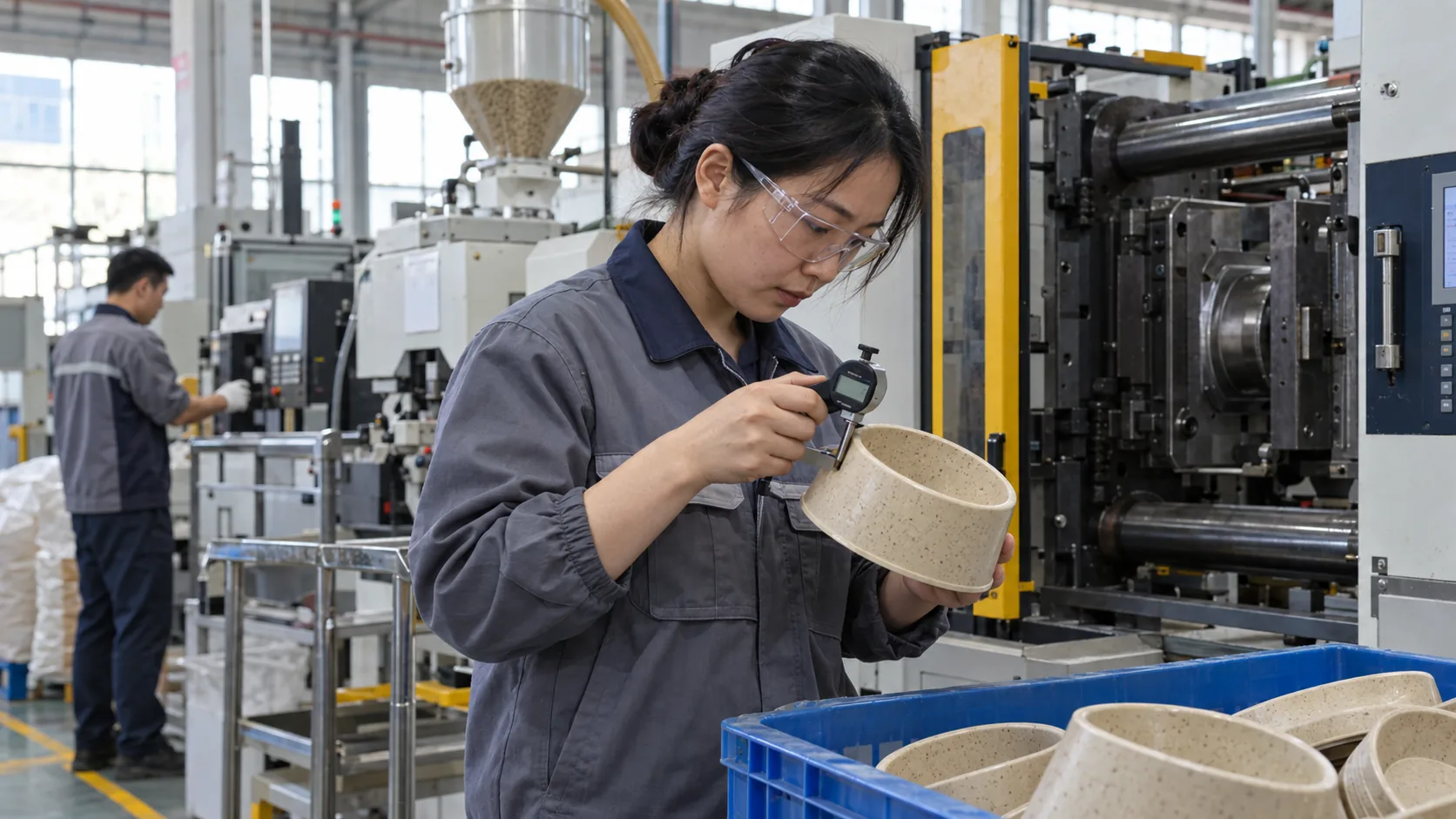
Plant-fiber PP is often more practical for reusable foodware, pet bowls and molded products that must tolerate boiling water, repeated loads or existing PP tooling, especially where industrial composting is unavailable. For example, P179 002N combines 31 MPa tensile strength, a 1,956 MPa flexural modulus and a 120°C HDT at 0.45 MPa with supporting FDA and LFGB food-contact tests.
Confirm the real service temperature, mechanical load, contacted food, disposal route, exact formulation and required migration standard before choosing a biodegradable or plant-fiber composite route.
Biodegradable Is Not the Same as Usable
“Biodegradable” is becoming one of the loudest labels in the plastics market. Tighter plastic restrictions, stronger sustainability commitments from brands, and rising consumer awareness have combined to push biodegradable materials into the spotlight. Yet one fact is repeatedly overlooked during material selection: biodegradable does not mean usable, fully biodegradable does not mean suitable for your product, and biodegradability and food safety belong to two entirely different evaluation tracks.
Treating fully biodegradable materials such as PLA as a universal answer is one of the most common—and most expensive—mistakes in sustainable material selection. This article examines three increasingly important misconceptions: performance limitations, food-safety risks associated with mineral-powder filling, and the real threshold for food-contact compliance. It then presents a practical alternative route that has already been proven on production lines.
| Selection Misconception | What It Overlooks | What Actually Determines Usability |
|---|---|---|
| Fully biodegradable is always the best environmental choice | Heat resistance, toughness, processing window, service life, and end-of-life infrastructure | Whether the material can survive production and the product’s real use conditions |
| Mineral-filled biodegradable plastic is automatically suitable for food contact | Overall migration, metal impurities, asbestos contamination, and filler grade | Formula-specific migration testing against the intended food simulant |
| A supplier or brand-level “food-grade” claim covers every material | Different resins, fillers, additives, colors, and loadings create different migration profiles | A traceable compliance chain for the exact material and formulation |
Misconception One: Treating “Fully Biodegradable” as the Only Correct Direction
A common assumption is that if a product is intended to be environmentally responsible, it should go all the way: only fully biodegradable materials such as PLA and PBAT count as genuinely sustainable. This logic ignores a fundamental question. In real applications, the performance of fully biodegradable materials often cannot support the demands placed on the product.
PLA’s weaknesses are largely structural. Its glass-transition temperature is approximately 55–60°C, and a finished part can begin to soften and deform above about 55°C. A cup of hot water can be enough for a PLA product to lose its shape. Its elongation at break is only about 2%–6%, which makes it a typically brittle material that can fracture under modest bending. Its processing window is also narrow: temperatures above 200°C or slightly elevated moisture can readily trigger thermal degradation and hydrolysis, causing a sharp drop in molecular weight. PBAT offers excellent flexibility, but not enough rigidity, so it is commonly blended with PLA.
More importantly, degradation itself depends on strict conditions. Under industrial composting conditions—temperatures above 58°C, humidity above 90%, and a suitable microbial community—PLA can reach more than 90% degradation within 180 days. The same material may take 800–1,200 days in home-composting conditions, while degrading very little in natural soil or marine environments. In other words, once most fully biodegradable products leave an industrial composting facility, their practical end-of-life behavior may differ little from that of conventional plastics.
The right question during material selection is not simply “Can it degrade?” It is “Can it withstand the way this product will actually be made and used?”
For pet toys that must withstand repeated chewing, appliance housings that carry assembly stress and long-term thermal loads, or household products that require stable dimensional accuracy, the performance ceiling of fully biodegradable materials is a hard constraint. A forced switch can trigger a chain of problems: lower processing yield, mold readjustment, and a sharply reduced product life. The combined conversion cost can be far more significant than the material price difference alone.
Misconception Two: Mineral Fillers Are a Hidden Weakness in Food-Contact Applications
If performance limitations are the visible problem in fully biodegradable materials, then the food-safety risks introduced by mineral-powder filling are the less visible—and potentially more serious—problem.
Why Mineral Powders Are Used So Widely
Fully biodegradable resins such as PLA and PBAT have narrow processing windows, slow crystallization rates, and low melt strength, which can lead to poor yields in direct injection molding or film blowing. Mineral fillers can address several issues at once. Inorganic fillers such as calcium carbonate, talc, and mica may cost only one-tenth to one-fifth as much as the resin, substantially lowering the compound cost. They also have a pronounced nucleating effect in PLA, increasing crystallization rate and crystallinity while improving stiffness and heat resistance. In addition, they can shorten molding cycles and raise extrusion output.
Mineral-powder filling is therefore common in modified PLA systems. Chinese standards allow talc at up to 30% in PLA plastic materials and articles. In one patented formulation for a biodegradable meal box, the PLA content was 55% while calcium sulfate filler accounted for 15%.
The problem is that biodegradability and food safety are entirely separate evaluation tracks. A material’s ability to degrade says nothing by itself about whether that material is safe when it contacts food.
| Mineral Filler | Why It Is Added | Food-Contact Concern | What Must Be Verified |
|---|---|---|---|
| Calcium carbonate | Cost reduction, nucleation, stiffness, and faster processing | Elevated overall migration into acidic food simulants as filler content rises | Overall migration and calcium migration in the intended acidic-contact condition |
| Talc | Nucleation, stiffness, dimensional control, and heat-performance improvement | Possible asbestos or asbestos-fiber contamination depending on the mineral source | Asbestos absence, metal impurities, filler purity, and application restrictions |
| Mica or other mineral powders | Rigidity, dimensional stability, and appearance control | Metal impurity migration and uncertainty when industrial-grade material is used | Food-contact grade documentation and formulation-specific migration testing |
There Are Clear Data Behind the Risk of Excessive Mineral Migration
Calcium carbonate provides a representative example. In a study of PLA/PBAT/CaCO₃ composite films, all five films with different calcium-carbonate contents exceeded the overall migration limit when tested with 3% acetic acid food simulant. Three-percent acetic acid is the standard medium used to represent acidic foods. Overall migration was driven mainly by the calcium-carbonate level in the composite film, and calcium concentration showed a linear relationship with total migration. This means that when a product made from such a material contains vinegar, lemon juice, tomato sauce, or another acidic food, the risk of excessive mineral migration is real and measurable.
Talc presents a different risk. Depending on the geological source, raw talc can contain associated impurities such as asbestos and asbestos fibers; asbestos is classified as a Group 1 carcinogen. Chinese requirements for PLA materials containing talc are explicit: the material must not contain asbestos, and PLA plastics and articles containing talc must not be used in contact with food intended for infants and young children or with breast milk.
In the physicochemical evaluation of food-contact materials, migration of metal impurities from inorganic fillers such as talc and calcium carbonate must be examined separately. When mineral-filler content reaches 20%–30%, raw-material purity is not an optional improvement. It is a basic safety requirement.
The Gray Area Around Industrial-Grade Mineral Powder
A deeper problem is the large price gap between industrial-grade and food-grade mineral powders, even though they may be almost impossible to distinguish visually. Industry investigations have reported that nearly 80% of meal boxes marketed as biodegradable were counterfeit or noncompliant. A genuinely biodegradable meal box can cost RMB 0.20–0.25 per unit, while a counterfeit version may cost only RMB 0.07—three to four times less to produce.
Some manufacturers obtain a production license and then cut costs by using large quantities of industrial-grade calcium carbonate, talc, paraffin, or other unsafe raw and auxiliary materials, sometimes together with recycled plastics of unknown origin. Disposable biodegradable meal boxes have repeatedly shown seriously excessive evaporation-residue results. Industry experts have also warned that low-quality meal boxes may contain heavy loadings of talc and calcium carbonate that do not dissolve in gastric acid or metabolize normally, creating concerns when the particles are ingested with food.
Every cent saved by filling with low-grade mineral powder can return as a much greater cost to consumer health and product liability.
Misconception Three: Food-Grade Certification Is Not a Brand Endorsement but a Material-by-Material, Formula-by-Formula Compliance Chain
The mineral-filler problem also points toward a practical conclusion: the supplier that makes food-contact compliance genuinely verifiable can establish a defensible advantage in a compliance-driven market.
Food-contact materials must answer specific questions. Does the formulation contain bisphenol A, phthalate plasticizers, or heavy metals? When it contacts oils, acidic food, or high temperatures, can it release excessive volatile organic compounds? The answers do not live in marketing claims. They are found in migration test reports for the exact material and exact formulation.
Commercial food-grade plant-fiber composites can now be supported by a verifiable compliance chain. German LFGB food-contact testing, US FDA sanitary requirements, and SGS testing are three basic checkpoints for entering mainstream markets. In 2026, China’s national food-safety standards system is also advancing. GB 4806.10-2025, Coatings and Coating Layers for Food-Contact Materials and Articles, took effect on September 2, 2026, providing a comparable, testable, and traceable compliance foundation for greener food-contact alternatives.
This means the compliance threshold for downstream factories and brands will continue to rise. If a material cannot pass the relevant FDA, LFGB, or GB 4806-series requirements, it cannot responsibly enter core applications such as tableware, pet feeding products, and food packaging.
A More Practical Route: Combining Plant Fiber with Conventional Petroleum-Based Resins
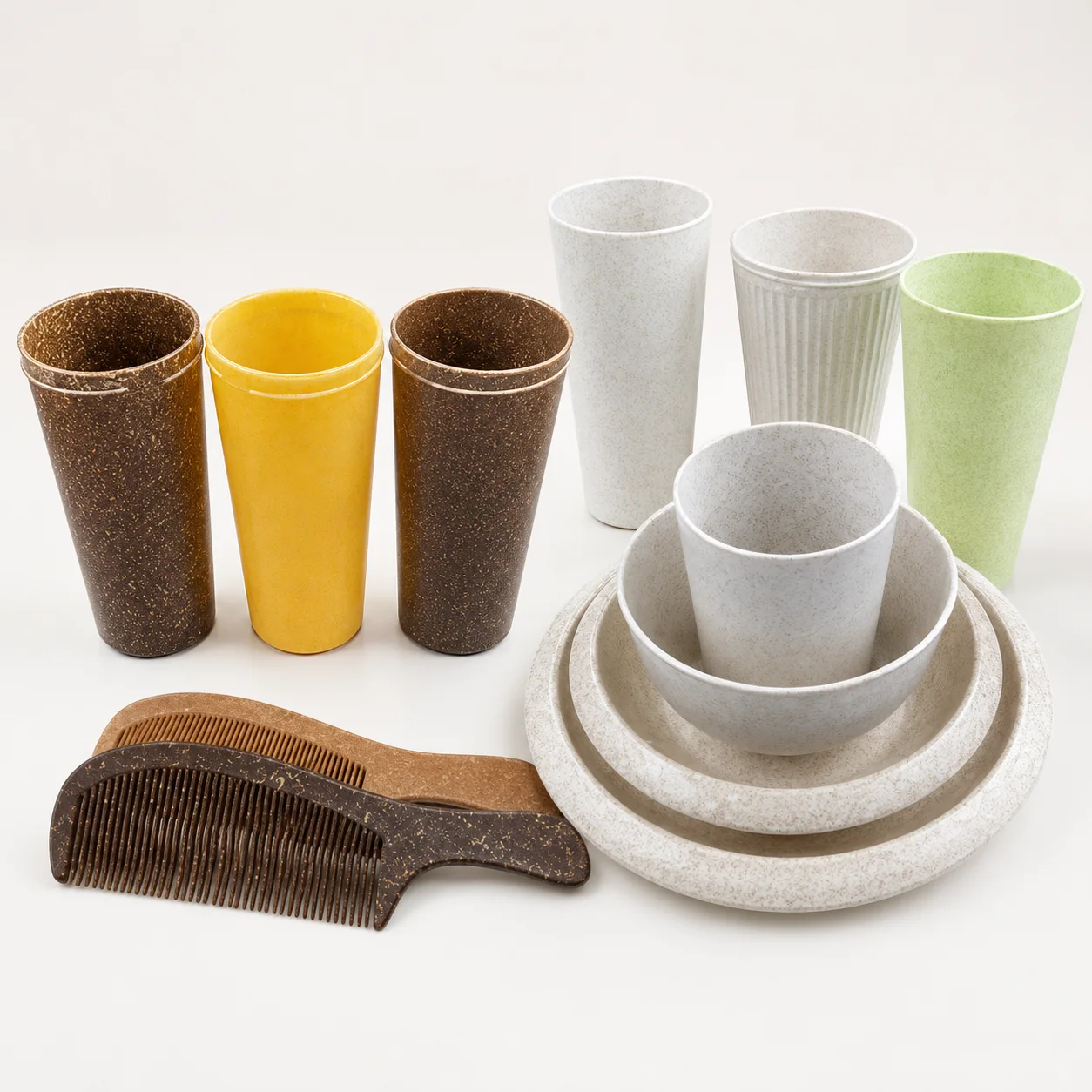
Ningbo Wanchong Technology, operating the wooyopet brand, offers a useful reference. Its approach is not to eliminate petroleum-based plastic altogether. Instead, natural plant fibers replace mineral powder as the filling and reinforcing phase. Through modified compounding, wheat straw, rice husk, bamboo fiber, wood fiber, coffee grounds, tea fiber, coconut coir, and other natural fibers are incorporated into conventional resin matrices such as PP, ABS, PA6, and PE.
The central advantage is that the processing system does not have to change. wooyopet materials are designed for mainstream processes such as injection molding and extrusion, allowing downstream factories to switch materials without replacing their existing production molds.
For food-contact compliance, this route reduces the risk chain associated with mineral powders. Finished articles made with wheat-straw composite PP, grade PP P179 002N, have passed US FDA and German LFGB food-contact tests. The material has a tensile strength of 31 MPa, a flexural modulus of 1,956 MPa, and a heat-deflection temperature of 120°C at a 0.45 MPa low load. In practical terms, pouring boiling water into a product does not cause it to soften or deform. Tea-fiber PP, grade P179-402N, has also passed food-contact safety testing. It is non-toxic and odor-neutral, carries a light natural tea aroma, has a flexural modulus of 1,450 MPa, and reaches a heat-deflection temperature of 122°C at 0.45 MPa. It also offers natural antibacterial performance, supporting odor control without relying on a chemical antibacterial agent.
| wooyopet Route | Compliance Position | Key Mechanical Data | Heat Performance | Practical Value |
|---|---|---|---|---|
| Wheat-straw PP P179 002N | Finished articles passed US FDA and German LFGB food-contact testing | Tensile strength 31 MPa; flexural modulus 1,956 MPa | HDT 120°C at 0.45 MPa | Food-contact articles that must tolerate boiling water without softening |
| Tea-fiber PP P179-402N | Passed food-contact safety testing | Flexural modulus 1,450 MPa | HDT 122°C at 0.45 MPa | Food-contact and pet products needing a natural appearance and odor-control direction |
The environmental value of these materials does not depend on claiming full biodegradability. It comes from reducing petroleum-resin use, increasing bio-based content, and extending product life. If a pet bowl made from plant-fiber composite PP lasts three times as long as an ordinary plastic version, it can prevent far more plastic waste than a PLA product that deforms and is discarded after only a few uses.
Production experience supports the route. When an East China pet-products brand developed a premium feeding bowl, it changed from a bamboo-fiber proposal to wooyopet’s wheat-straw formulation. After the mold temperature was raised from 50°C to 65°C, injection speed was reduced by 15%, and holding time was extended by two seconds, the stable mass-production yield exceeded 96%. No warpage or deformation complaints were reported for the finished product.
Coffee-ground ABS has also entered the supply chain of a European coffee chain. The injection-molding cycle for its stirrers was held below 25 seconds. The finished part had a deep brown color and visible fine coffee-ground particles, achieving the desired appearance without spraying, while also passing food-contact safety testing.
When Full Degradability Is Genuinely Required, a More Practical Option Still Exists
For products that must enter a composting system, full degradation is a fixed requirement and cannot be avoided. Even then, pure PLA is not the only possible route.
wooyopet’s fully degradable masterbatch takes another approach. By adding 2%–3% degradable masterbatch to PP without changing the base material, a conventional PP product can achieve a reported degradation rate above 90%. The masterbatch is mainly composed of organic materials such as polylactic acid and monosaccharides. It works by attracting microorganisms that attack the polymer structure, with a typical degradation period of three to five years.
The commercial value of this route is defined by three things it is designed not to sacrifice.
Processing Performance Is Preserved
PP melt flow, injection cycle, and mold compatibility are retained. A downstream factory does not have to replace its base material or rebuild its injection-molding equipment, keeping conversion costs low.
In-Use Performance Is Preserved
PP heat resistance, rigidity, and chemical resistance are retained. The finished product can contact boiling water and withstand ordinary mechanical loads, while a PLA product may deform under the same conditions.
The Cost Advantage Is Preserved
PLA resin costs approximately RMB 18,000–24,000 per metric ton, while PP costs substantially less. Adding a small amount of degradable masterbatch therefore creates a more controllable cost increase.
The cost trade-off still needs to be stated clearly. Compared with ordinary PP, this route has a higher material cost, and the finished product may carry a 35%–100% premium. If the target market is highly cost-sensitive, the business case must be calculated before the material route is chosen.
Selection Guidance: Start with the Use Case, Then Choose the Material
Instead of starting with “Which material is the greenest?”, begin with three practical facts: where the product will be used, where it will go after disposal, and what media it will contact. Four questions provide a fast selection framework.
| Question | If the Answer Is Demanding | Practical Material Direction |
|---|---|---|
| How high are the mechanical-performance requirements? | The part carries loads, resists impact, or is used repeatedly | Fully biodegradable materials are unlikely to be sufficient; consider plant-fiber composites based on conventional resins |
| Will the product contact food, and what type? | It contacts acidic foods, oils, or hot liquids | Avoid assuming mineral-filled biodegradable plastic is safe; prioritize a formulation supported by FDA/LFGB or relevant GB 4806 testing |
| What treatment system will the product actually enter after disposal? | No industrial composting infrastructure is available | The environmental benefit of a fully biodegradable material may not be realized; focus on using less material and extending service life |
| How cost-sensitive is the market? | The acceptable premium is limited | Plant-fiber composites are often close to or slightly above conventional plastics, while fully biodegradable routes usually carry a much larger premium |
wooyopet’s approach is worth examining because it does not equate “environmentally responsible” with “biodegradable.” By combining plant fibers with conventional resins, it seeks a more workable balance among material performance, food-contact compliance, processing feasibility, and environmental value.
For most products, that balance matters more than a “fully biodegradable” label. In food-contact applications, food safety is a condition of market entry, not an optional feature—and it should rank ahead of every environmental claim in the material-selection decision.