
Less Plastic, More Plant: WOOYOPET's report on a survey of 300 consumers about plant-fiber environmental materials
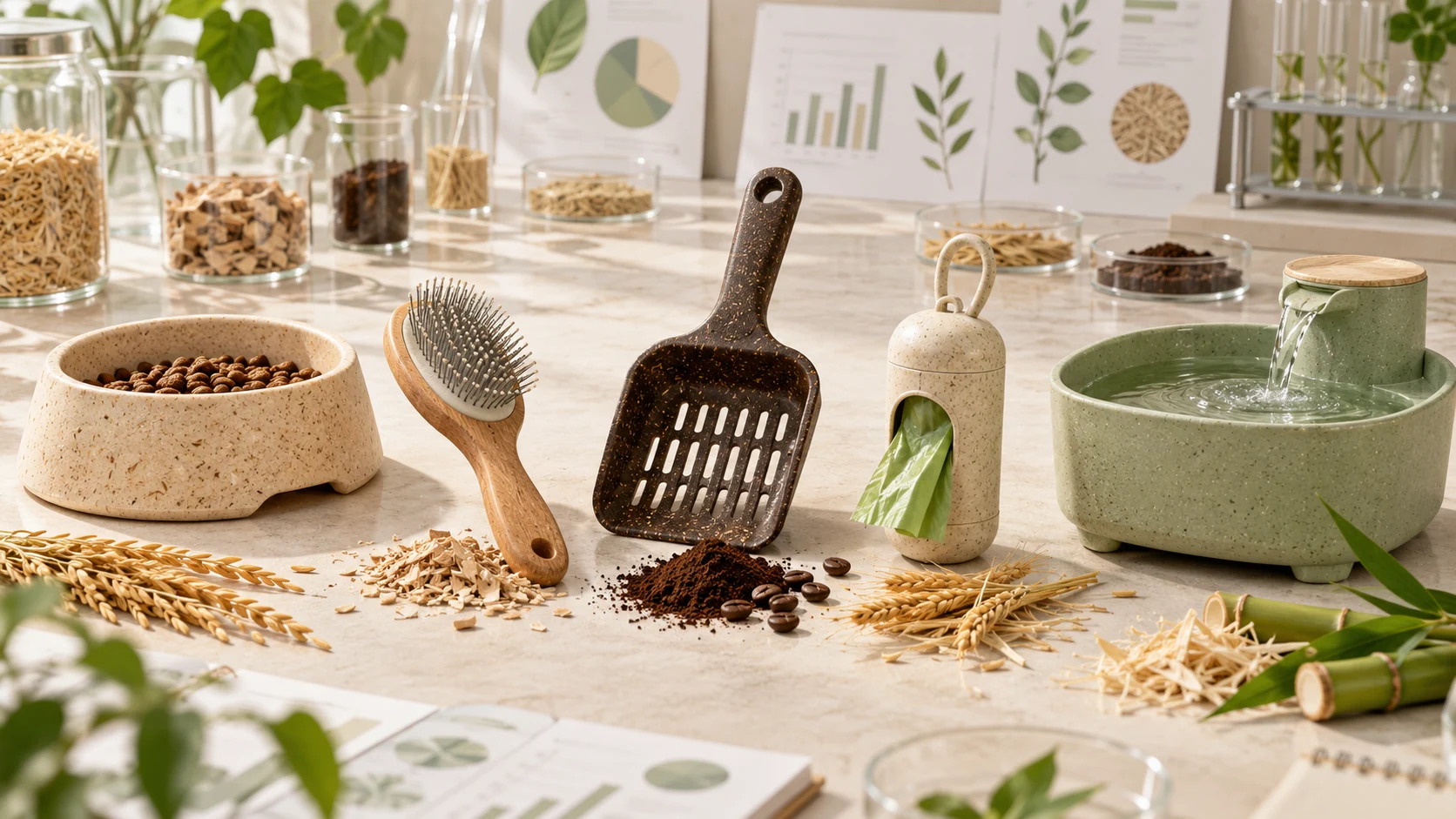
In March–April 2026, wooyopet asked 300 consumers in China, Japan, Southeast Asia, Europe and the Americas whether reducing part of the plastic still counts, which plant byproducts they trust, and how much more they would pay. Five anonymized pet-product projects — a rice-husk feeding bowl, a coffee-ground litter scoop, a wood-fiber grooming brush, a wheat-straw bag dispenser and a bamboo fountain base — show what that means in tonnes: about 37.4 tonnes of fossil-derived material displaced per year.
Buyer and engineer FAQ
Questions about plant-fiber composite plastics and plastic-reduction claims
How do we turn a plant-fiber percentage into a plastic-reduction figure a customer can check?
Multiply the finished part mass by the plant-component fraction and then by the annual unit volume, and publish all three inputs with the result. For the rice-husk bowl in this article: 186 g × 28% = 52.08 g per bowl, and 350,000 bowls give 18.228 t/year, reported as 18.23 t. Keep unrounded values for any total, name the conventional formulation you compare against, and recalculate after masterbatch dilution — the buyer receives the plant fraction of the molded article, not of the pellet.
What production problems appear first when a plant-fiber compound replaces part of PP or ABS?
Moisture comes first, because plant fillers absorb water; drying profiles and incoming moisture checks decide whether a run produces silver streaks, voids and unstable impact strength. Then expect particle-size and dispersion effects (agglomerates become surface defects and weak points), a melt-flow shift that changes filling and clamp settings, lower weld-line strength on thin or ribbed geometry, and batch-to-batch color variation. Plan a trial matrix for drying, dosing, temperature profile and tool venting, and validate on the finished article rather than on a plaque alone.
The survey reports that 85.7% would accept a higher price. How much can we charge?
Treat it as stated willingness, not observed purchasing. Of 300 respondents, 257 (85.7%) accepted some premium: 91 people (30.3%) chose 0–5% and 102 (34.0%) chose 5–10%, so roughly two thirds sit at or below 10%; 48 (16.0%) accepted 10–20% and 16 (5.3%) more than 20%. Use those bands to design a value-based price test on one SKU, and remember that 236 of the 300 respondents (78.7%) were in China, so the pattern is not a global price benchmark.
Which claims can we publish now, and which need project-level testing?
Plant content by mass and the calculated mass substitution can be published when you name the plant source, the fraction, the part mass, the annual volume and the conventional baseline. Carbon figures need a defined life-cycle boundary and a supporting assessment, because collection, drying, compounding, yield and end-of-life treatment all change the result. Food-contact suitability, drop performance, weathering and biodegradability must be established on the finished article for the intended market; a pellet test report or a plant-content percentage cannot carry any of them.
What does the wood-fiber brush case still not prove?
The source material does not separate the ABS and TPE masses of the original 112 g handle, so the 33.6 g figure assumes that the whole product mass carries the 30% plant fraction. That makes it a conditional whole-product estimate, not a verified 33.6 g reduction in ABS. A production claim would need the composite part mass, a like-for-like baseline of comparable finished mass, and the confirmed annual volume.
For a project-level claim, document the exact part mass, final composition, conventional baseline, production volume and validation tests.
When it comes to plastic, we have been waiting far too long. We wait for more mature fully degradable materials, for a more complete recycling system, for a new material that is cheap, durable, water-resistant, heat-resistant and easy to process, while also breaking free of fossil resources altogether. We always hope the next material will solve every problem at once, and so, while we wait, a great many everyday products are still manufactured the way they have been for decades: a pet feeding bowl uses 100% fossil-derived PP, a comb uses ABS, a small household item keeps using brand-new fossil-derived resin.
Many of these products will not stop being made tomorrow. Nor will consumers stop needing pet products, household goods, appliance housings, storage items or everyday tools from tomorrow onwards simply because of environmental problems. So for people who genuinely want to reduce plastic and fossil resource use, there may be a more realistic question worth discussing seriously:
Before that ideal “plastic-free future” actually arrives, how much fossil-derived plastic can we take out of the products being made today? If a product that originally needed 100 g of PP can use only 75 g of PP without noticeably changing its service life or function, with the remaining 25 g carried by rice husks, wheat straw, coffee grounds, wood fiber or bamboo fiber, then it is of course still not a “plastic-free product”.
But those 25 g of fossil-derived plastic really were not used. One product is 25 g. A hundred thousand units is 2.5 tonnes. A million units is 25 tonnes. If this change reaches dozens or hundreds of kinds of product that are going to be manufactured every day anyway, then “a little less plastic” stops being merely a symbolic environmental gesture and gradually becomes a real reduction in raw material.
This is also the most central starting point of wooyopet’s research into plant-fiber composites. We do not want to use plant fiber to defend plastic, and we do not believe that adding plants to plastic makes it easy to put “green”, “sustainable” or even “zero burden” labels on a product. What genuinely interests us is a more concrete question:
If this product still has to use plastic today, can we at least let it use a little less? A little less oil. A little more plant. Not waiting until every condition is perfect before starting. But starting with the next product.
01 | What makes plant fiber genuinely meaningful is entering the products that still cannot do without plastic
Disposable straws, excessive packaging and unnecessary single-use bags should simply be reduced, and that is the part where consensus is relatively easy to form. What is genuinely difficult is another category of product. A pet feeding bowl has to be in contact with water and food over the long term and be washed repeatedly; a waste-bag dispenser has a clip that opens and closes again and again and also has to withstand outdoor use; a pet grooming brush handle needs dimensional stability and a comfortable grip, and will also come into contact with skin oils and cleaning agents; a litter scoop gets dropped, bent and knocked; and the base of a smart pet watering device not only has to resist water but also has to combine with a modern home environment and electronic equipment.
These products have long used materials such as PP, PE and ABS not only because plastic is cheap, but because plastic genuinely solves very specific engineering problems. So if a so-called environmentally friendly material can only look attractive in a display case but cannot enter existing molds, production lines and real use environments, then its help in reducing fossil-derived plastic at scale remains limited.
What genuinely attracts us to plant-fiber composites is precisely that they try to cross this barrier. Plant-derived materials such as wheat straw, rice husks, coffee grounds, bamboo fiber, wood fiber and coconut coir can, after screening, drying, milling, particle-size control and the necessary interface treatment, be compounded with mature thermoplastics such as PP, PE, ABS and PA, and then be turned back into industrial pellets through twin-screw extrusion.
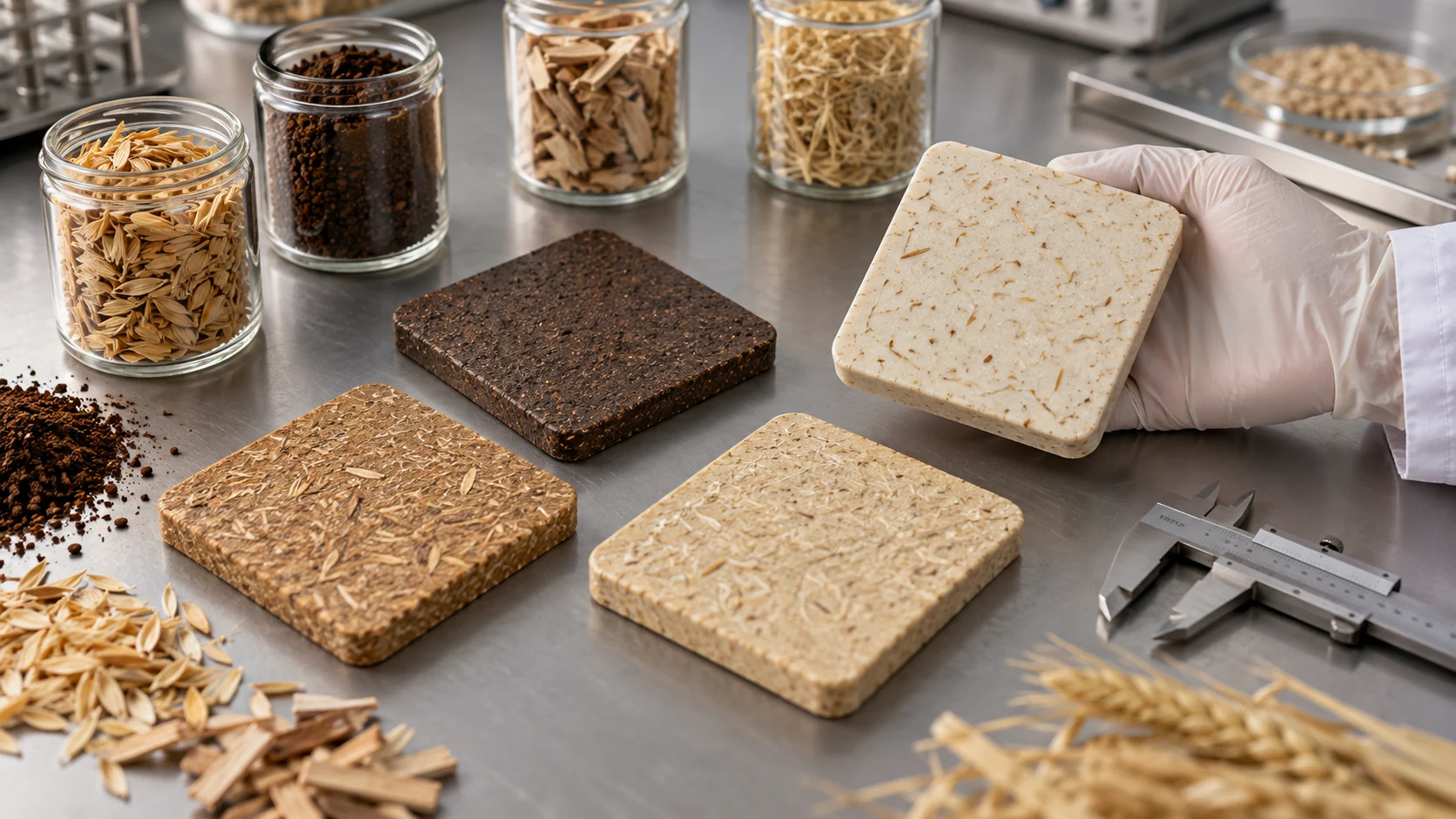
In the end it can still be transported to a plastics factory, fed into the hopper, go through injection molding or extrusion, and finally become a real product. The manufacturing system does not need to be torn down and rebuilt overnight. What really changes is the material formulation. Where 100 parts of material all depended on fossil-derived polymers in the past, 15, 20, 25 or 30 of those parts may now come from plants.
From the standpoint of environmental ideals, this may still not be thorough enough. But from the standpoint of manufacturing scale, it has one very important advantage: It has the chance to happen today. This is also why we prefer to understand plant-fiber composites as a “plastic-reducing material”, rather than forcing a grander label onto them.
It has not promised that plastic will disappear. What it does is loosen a dependence on fossil-derived material that was previously 100%.
02 | 300 consumers gave a very clear answer: they do not believe that failing to reach zero in one step means nothing
Materials engineers often underestimate consumers’ ability to understand materials. A very common worry is this: If consumers are told “this still contains plastic”, will environmentally conscious consumers reject it immediately? To test this question further, between March and April 2026 WOOYOPET carried out a consumer survey on plant-fiber composites and obtained 300 valid samples. Of these, 96 participants handled physical samples, while the other 204 completed the survey through a questionnaire. Respondents covered China, Japan, Southeast Asia, Europe and the Americas, and other regions, and were mainly aged 18–44.
We did not simply ask “do you support environmental protection?” We wanted to know how people actually choose when environmental ideals and real products are placed side by side. One of the most notable results in the survey was this: Of the 300 respondents, 261 agreed: Even if a product has not yet become completely plastic-free, as long as it can reduce conventional plastic use, that change in itself has environmental meaning.
That is: 87.0%. In sharp contrast, of 298 valid answers, only 21 people held that: “As long as it still contains conventional plastic, it cannot count as an environmental improvement.” A share of only: 7.0%. Placed together, these two figures are more valuable than simply saying “consumers like environmentally friendly products”.
They show that, at least within this sample, the great majority of consumers did not understand material transition as a black-and-white multiple-choice question. Not being 100% plastic-free does not equal a score of zero. That logic is not the mainstream among real consumers. At the same time, once consumers clearly learned that “this product reduces fossil-derived plastic use”, 238 of 296 valid answers said their impression of the product would become more positive, accounting for:
80.4%. And where product performance was close, 217 of 300 said they would be more willing to buy plant-fiber composite products, accounting for: 72.3%
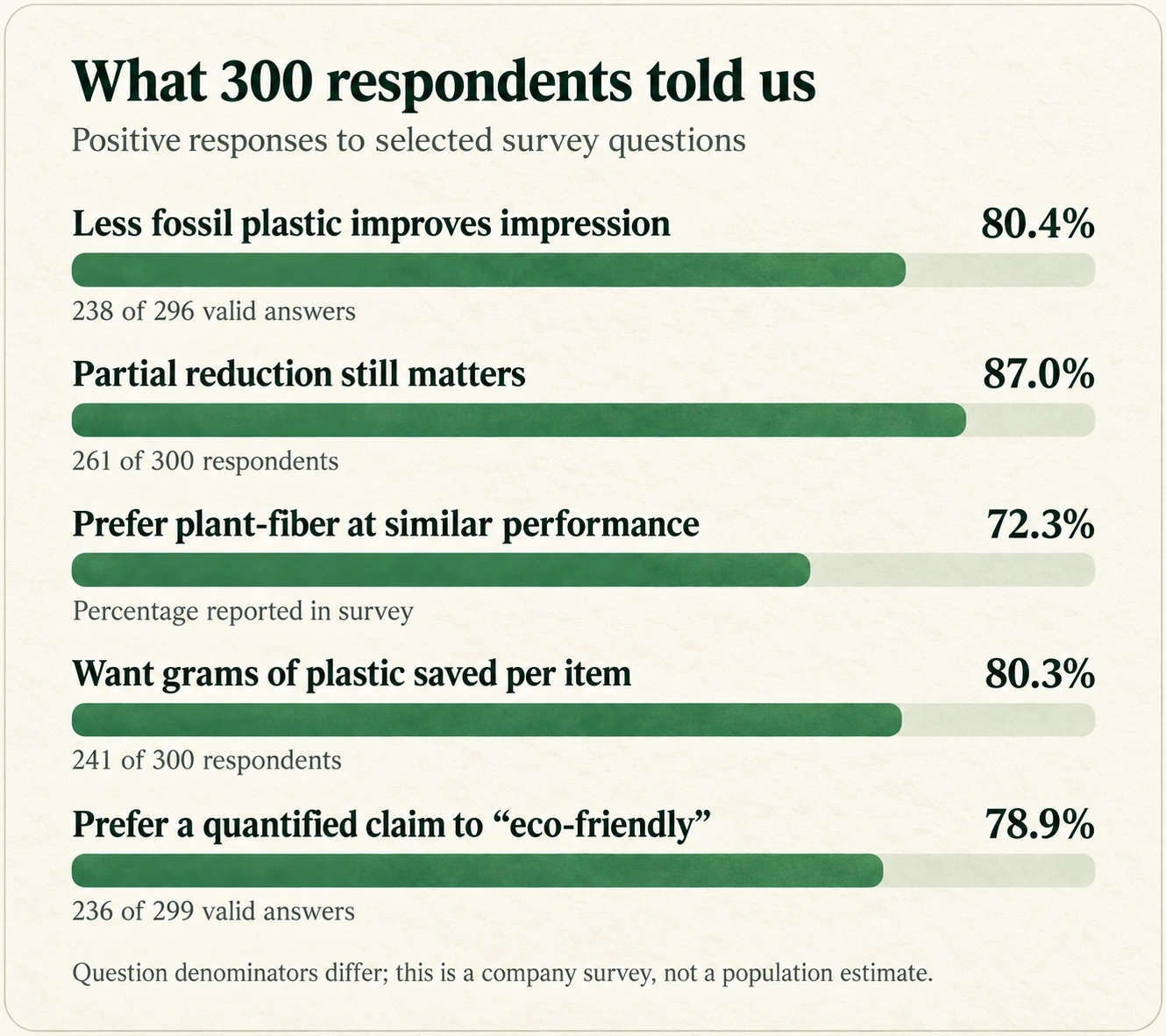
This gives plant-fiber composites a very important real-world foundation: Consumers not only accept “incremental plastic reduction” in principle; that acceptance also has a chance to translate further into purchase intention. This is very important for our understanding of green consumption. People certainly hope that one day materials can break free of fossil resources more thoroughly, but many do not believe that, before that future arrives, we should be indifferent to a 20%, 25% or 30% reduction.
Because a reduction is not “pretending to solve”. A reduction is itself a reduction.
03 | Green consumers no longer want to see just a green leaf, but “exactly how much less did you use”
For a very long time, the way sustainable products most commonly expressed themselves was very similar. Green packaging. A leaf icon. “Eco”. “Natural”. “Sustainable”. These words can of course communicate a brand’s attitude quickly, but the problem has become increasingly obvious: once almost every brand can use similar language, it is hard for consumers to know from a few adjectives alone what a product has actually changed.
WOOYOPET’s 300-person survey reflects this shift very well. Of the 300, 241 people, that is: 80.3%. want to know exactly how many grams of plastic a product uses less. Of 299 valid answers, 236 held that: “Using XX grams less plastic” is more credible than simply writing “Eco-Friendly”. A share reaching: 78.9%. In addition, 228 consumers said:
that if a brand is willing to disclose a specific plastic reduction, it would improve their opinion of that brand. Accounting for: 76.0%. These few data points in fact point to the same question: Consumers are not short of more “environmental adjectives”. What they lack are facts that can be understood. For example, if an 186 g pet feeding bowl has 28% of its mass carried by a rice-husk plant component, then consumers do not need to understand complex polymer science to know:
that roughly 52 g of the material in this product is no longer carried by fossil-derived PP. If 350,000 units are produced in a year, that is more than 18 tonnes. Compared with a phrase like “uses environmentally friendly materials”, the biggest difference in this way of putting it is that it gives consumers a sense of scale.
Environmental protection finally stops being only “it feels good”. And becomes: what this one product has actually changed. This is also why WOOYOPET increasingly wants to promote one simple metric:
Plastic Displacement
It is not a complete life-cycle assessment, and it cannot replace a carbon footprint calculation. It answers only one very basic question that was often overlooked in the past: Because we used this material, exactly how much fossil-derived plastic did we avoid? If a product weighs 180 g and the plant component accounts for 25%, then roughly 45 g of the material is carried by plants.
Producing 300,000 units a year makes that 13.5 tonnes. When more and more products are willing to disclose numbers like these, sustainable materials will become more transparent.
04 | Consumers like “visible plants”, but that does not mean rougher is better
Plant-fiber composites have another very particular quality: Consumers can directly see that the material has changed. This is different from many environmental measures hidden deep in the supply chain. When a product uses green electricity, consumers usually cannot feel it in their hands; when a supply chain shortens a transport distance, consumers do not see it directly either.
But plant fiber is different. Coffee grounds leave natural dark flecks. Rice husks form a fine, irregular grain. Wood fiber gives the surface a warmer quality. Wheat straw and bamboo fiber, too, bring subtle changes to what was originally a highly uniform plastic surface. In WOOYOPET’s survey, 214 of 298 valid answers clearly said they liked being able to see natural plant fiber or particles on a product’s surface, accounting for:
71.8%. Of 297 valid answers, 206 held that this “visible plant” enhances the material’s authenticity, accounting for: 69.4%. But more interesting is that when we compared different appearances further, consumers did not choose “the stronger the plant feel, the better”. Of the 300: conventional solid-color plastic received 52 votes, or 17.3%;
a very subtle, barely visible plant texture received 96 votes, or 32.0%; material in which plant fiber or natural particles can clearly be seen received the highest number, 118 votes, or 39.3%; and material with a very coarse, strongly natural texture received only 34 votes, or 11.3%.
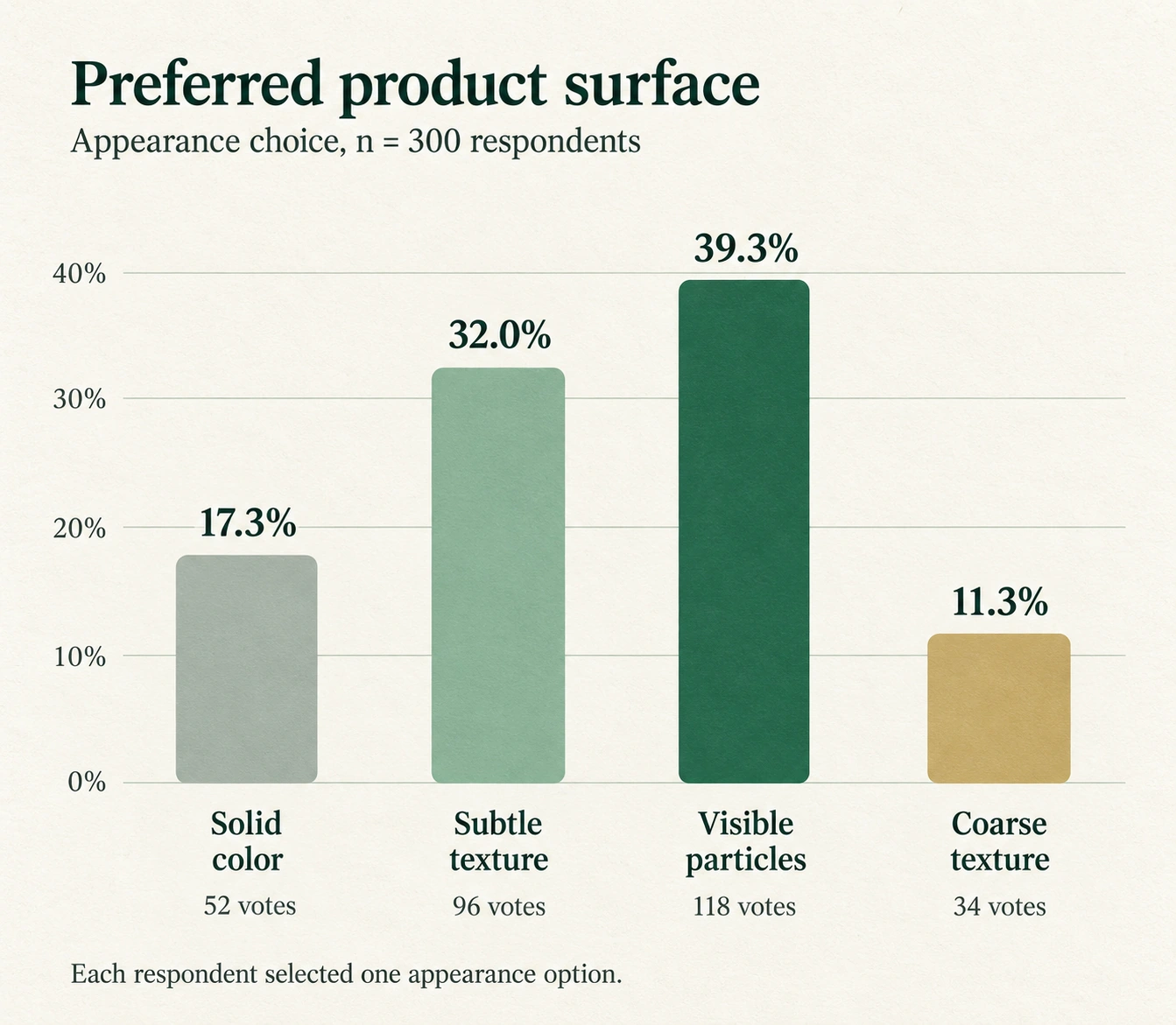
In other words, what consumers like best is not turning a modern product into something that looks like unprocessed plant residue. What they really like is a balance. It should still first of all be a highly finished product. But when you come closer, you can see that the plant genuinely exists inside it. This feeling changes people’s traditional perception of a plastic surface.
In the past, industrial plastics worked hard to eliminate difference. The color had to be the same. The surface had to be the same. The texture had to be the same. Every product should ideally look as if it had been copied endlessly from the same mold. Plant fiber, however, brings a different aesthetic. Slight differences between natural particles are allowed.
Not every fleck of coffee grounds has to be identical. Wood fiber does not need to be completely hidden either. This incomplete uniformity sometimes makes consumers feel instead: The material is real.
05 | When coffee grounds, rice husks and wheat straw have a second life, environmental value becomes very easy to understand
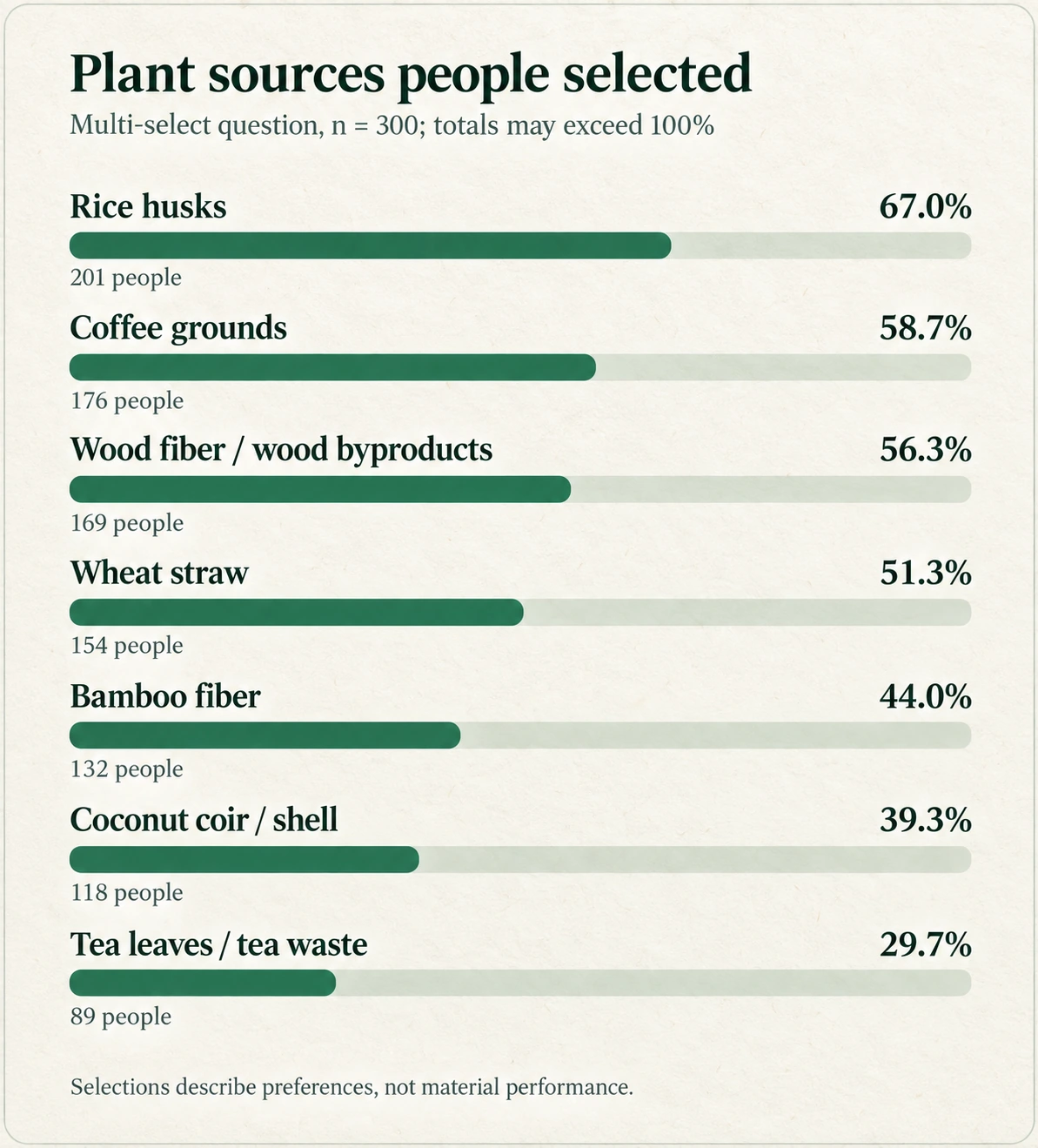
In the survey on preferences among different plant sources, the results we obtained were equally interesting. This was a multiple-choice question. Of the 300 consumers: rice husks received 201 selections, or 67.0%; coffee grounds received 176, or 58.7%; wood fiber and wood-processing residues received 169, or 56.3%; wheat straw 154, or 51.3%;
bamboo fiber 132, or 44.0%; coconut coir and coconut shell fiber 118, or 39.3%; tea leaves or tea residue 89, or 29.7%.
Compared with an unfamiliar “bio-based filler”, consumers seem more easily to develop a feeling for plant sources they can understand from their own lives. After finishing a cup of coffee, we know what coffee grounds are. Having eaten rice, we can also understand where rice husks come from. Wheat leaves straw behind after harvest, and that needs no complicated environmental education.
This understanding showed up especially in another question. Of 298 valid answers, 203 said: that if given the choice, they would prefer by-products already generated by agriculture or food processing rather than growing plants specifically in order to make filler. A share of: 68.1%. At the same time, 82.0% of respondents held a positive attitude towards reusing agricultural and food by-products such as coffee grounds and rice husks.
This is the point where we think plant-fiber materials are very compelling. It does not only say: “There are plants in here.” It is saying: This thing has already completed its first mission — can we let it be used one more time? The coffee has been drunk. But the coffee grounds are still there. The rice has been eaten. But the rice husks are still there.
The timber has been through its first processing. But the remaining wood fiber is still there. After the wheat is harvested, the straw still exists. For someone who genuinely cares about wasted resources, this logic hardly needs explaining. The question is not “why reuse it”. The real question should instead be: Since it can still become a material, why must we keep using more fossil-derived raw material?
06 | Starting from a pet feeding bowl: only when plant fiber enters real products does plastic reduction stop being an idea
What really formed this understanding at WOOYOPET was not only the questionnaire. More important were individual, concrete products.
Rice-husk pet feeding bowl: one bowl avoids 52 g of PP, which is 18.23 tonnes a year
A Chinese pet-products project originally used 100% PP to make a pet feeding bowl. The requirement the customer raised was very realistic. They certainly wanted to reduce conventional PP use and to give the product a clearer environmental selling point, but a pet feeding bowl must first of all still be a qualified bowl. It has to be in contact with water over the long term.
It has to be washed repeatedly. It needs to keep its structure stable. The color cannot vary from batch to batch. Because it involves a pet feeding scenario, food-contact requirements also had to be considered. In the end the project used a 28% rice-husk plant component. A single product weighs 186 g, with projected annual output of 350,000 units.
This means that in every product there are approximately: 52.08 g. of material carried by plant-derived components. On a single feeding bowl, 52 g really is not much. But across 350,000 bowls, the corresponding theoretical fossil-derived material displacement is approximately: 18.23 t/year. What is really interesting about this case is not only the 18.23 tonnes.
It is that the product ultimately did not sacrifice its identity as an everyday item in order to “look environmentally friendly”. The sample surface retained fine rice-husk particles and presented an overall matte, natural quality; structural strength met the project requirements, and the existing mold could largely continue to be used, with only drying and feeding parameters needing adjustment for the plant fiber.
The feedback the customer gave when they first saw the sample was very direct: “It looks more natural, not like ordinary plastic.” At the same time, they also quickly raised the questions that only real consumers care about: Will the plant particles on the surface trap dirt? Will cleaning become more troublesome? So the material could not merely keep a “natural feel”; the surface still needed to be dense enough.
This is perhaps more real than any environmental advertisement. Once sustainable materials genuinely enter daily life, consumers will certainly wash them, drop them, knock them and use them over the long term. Only by getting past these questions does the theoretical displacement of 18.23 tonnes really mean anything.
Coffee-ground litter scoop: an environmental story has to survive a drop first
Another project came from the direction of Japanese pet cleaning products. The customer was developing a litter scoop, and the raw material used ABS. They wanted to reduce conventional plastic, and at the same time wanted the material to carry a story consumers could understand at a glance. So coffee grounds became a very natural choice.
“The coffee you have finished can become a litter scoop.” That sentence alone is enough to arouse interest. But for material development, the story is only the beginning. A litter scoop bends. It falls on the ground. The handle needs to be non-slip. The coffee grounds’ own odor, color, moisture content and particle size all affect the final article.
The final formulation used a 22% coffee-ground plant component, with a single product weight of 78 g and projected annual production of 120,000 units. The theoretical fossil-derived material displaced by each product is approximately: 17.16 g. For the full year, approximately: 2.06 t. The final sample formed a distinct but not excessively coarse dark coffee-ground texture, the handle had a frosted feel, and the drop test required by the project was completed.
The customer very much liked the communicability that “coffee grounds” itself brings. Because ordinary consumers do not need to learn new environmental vocabulary. They only need to know: The coffee grounds that might have gone into the bin yesterday became part of a product today. That is enough.
Wood-fiber pet grooming brush: reducing ABS can also give the product more quality
A German pet grooming-tool customer’s original product used an ABS+TPE system. The customer wanted to reduce ABS use while giving the product a more natural wood feel. The final direction used 30% wood fiber and wood-processing residues. A single item weighs 112 g, with projected annual production of 80,000 units. In each product approximately 33.6 g of material is carried by the plant component, and the theoretical annual displacement is approximately:
2.69 t. This case illustrates very well why the plant ratio is not the only goal. What the customer ultimately cared about was dimensional stability, grease resistance and how it really feels in the hand. Wood fiber gave the product a more natural texture and a warmer, softer feel, and the sample’s visual effect also received positive feedback.
But wood fiber absorbs moisture easily, so drying management before injection molding became more important. Some edges of the product also needed further optimization. From an environmental point of view, we could of course advertise only “30% plant component”. But from the point of view of real manufacturing, what matters more is:
This 30% genuinely went into 80,000 products that can be used.
Wheat-straw waste-bag dispenser: 11 g is also worth calculating carefully
There is another category of product that is especially easy to overlook. Because it is too light. A pet waste-bag dispenser weighs only 45 g. The customer comes from the US pet outdoor-products market; the original product used a PE/PP system, and they wanted to reduce plastic use while keeping cost controllable and brand printing capability.
In the end a 25% wheat-straw plant component was used. So the theoretical fossil-derived material reduced by each product is only: 11.25 g. This number is so small that it has almost no “publicity impact”. But the projected annual output of this product is: 500,000 units. So 11.25 g eventually becomes: 5.63 t/year. This is where scale manufacturing is easiest to overlook.
Environmental discussions often like a particularly striking single-item number. But in reality, what may really matter is: a very small change, repeated 500,000 times.
Bamboo-fiber pet fountain base: plant material can enter a smart-home setting too
Another project was a fountain base/bowl support in smart pet products. The customer originally used PP, and wanted to reduce conventional resin use while making a smart pet device look more like a piece of furniture in a home space than a very industrial plastic device. The final formulation added 20% bamboo fiber. A single item weighs 220 g.
Projected annual production is 200,000 units. Theoretical displacement per product: 44 g. of fossil-derived material. Over a year, approximately: 8.8 t. The final product retained a fine bamboo-fiber texture, the color was more natural, and rigidity increased somewhat. Consumers gave the sample a very interesting comment: “More like something for the home.”
This sentence in fact illustrates another value of plant fiber that is often overlooked. It does not necessarily have to make a product look “like nature”. Sometimes, simply reducing the coldness and complete uniformity of a plastic surface is enough to change the relationship between a person and a product.
07 | Five ordinary products, 37.4 tonnes a year: what is worth imagining is scale, not one “eco sample”
Putting the five projects above together: Rice-husk pet feeding bowl: 18.23 t/year. Coffee-ground litter scoop: 2.06 t/year. Wood-fiber pet grooming brush: 2.69 t/year. Wheat-straw waste-bag dispenser: 5.63 t/year. Bamboo-fiber pet fountain base: 8.80 t/year. Total, approximately: 37.40 t/year of fossil-derived material
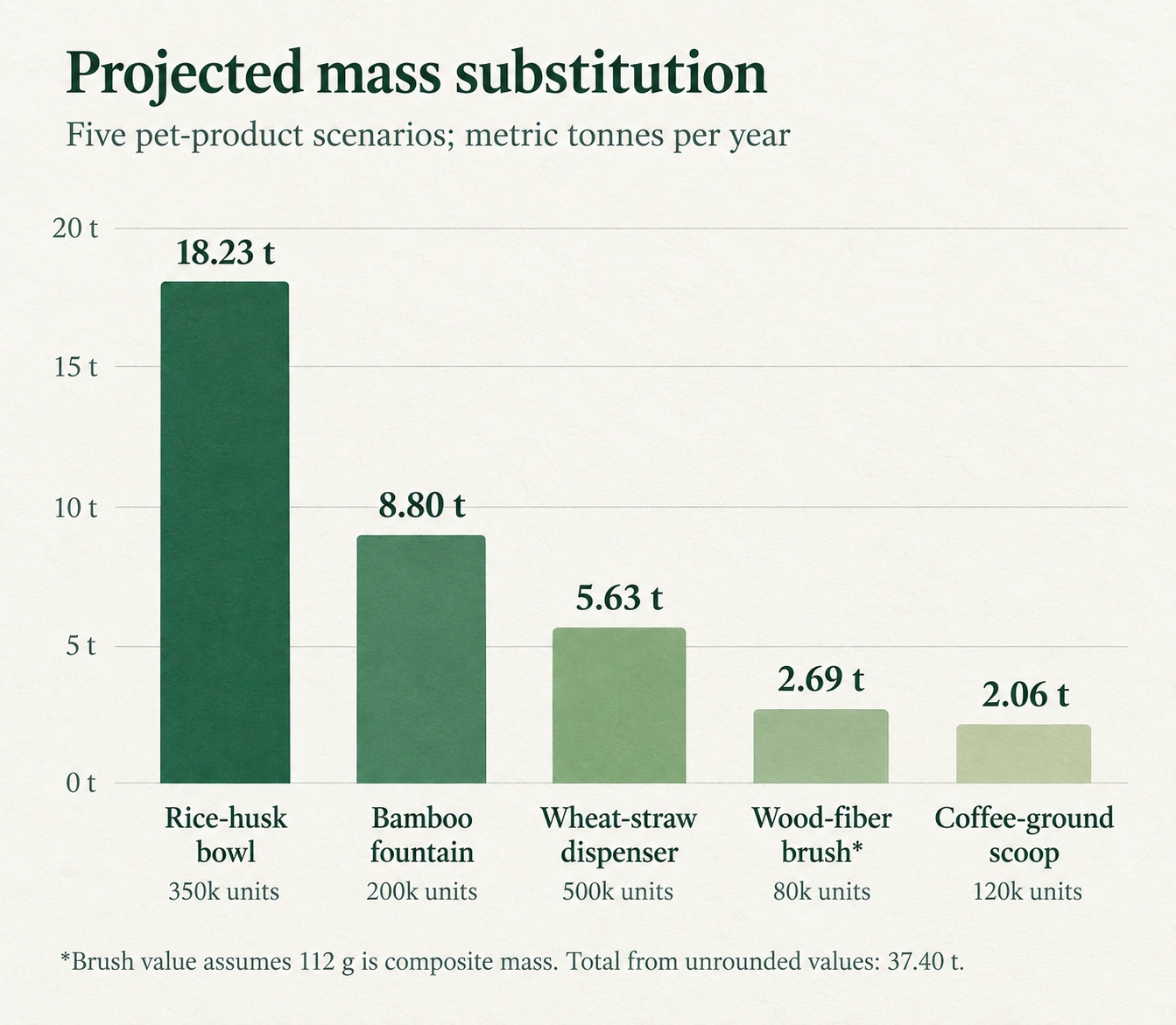
Not one of these five products can solve the global plastic problem on its own. They are all, in fact, extremely ordinary pet products. But we think this is precisely what makes this set of numbers most worth attention. If five such ordinary products, through the use of roughly 20%–30% plant fiber, can form an annual displacement of about 37 tonnes of fossil-derived material, then the question naturally extends further:
What about a brand with 30 SKUs? What about a large retail enterprise? What about a household-goods category? And what about more consumer scenarios — pet products, appliance housings, storage, gardening, automotive interiors and more? This is what we understand by reducing plastic. It may not produce a product that “saves the planet”.
What it does is make the products that are manufactured every day use a little less fossil-derived plastic, one by one. And then, relying on industrial scale, accumulate all those “little bits”.
08 | Green consumers did not reject it because it still contains plastic; quite the opposite
To understand exactly what relationship exists between plant-fiber composites and environmental awareness, we also grouped the 300 respondents by their level of environmental concern. The results showed a very clear gradient. Of the 72 people who were “very concerned about the environment”, 68 accepted plant-fiber composite plastic:
94.4%. Of the 108 who were “fairly concerned about the environment”, 94 accepted: 87.0%. Of the 84 who were “moderately concerned”, 66 accepted: 78.6%. Of the 28 who were “not very concerned”, 16 accepted: 57.1%. And of the 8 consumers who were “not concerned about the environment at all”, only 3 accepted: 37.5%. If “very concerned” and “fairly concerned” are combined:
Of 180 consumers with high environmental concern, 162 in total accepted plant-fiber composites. The acceptance rate reaches: 90.0%
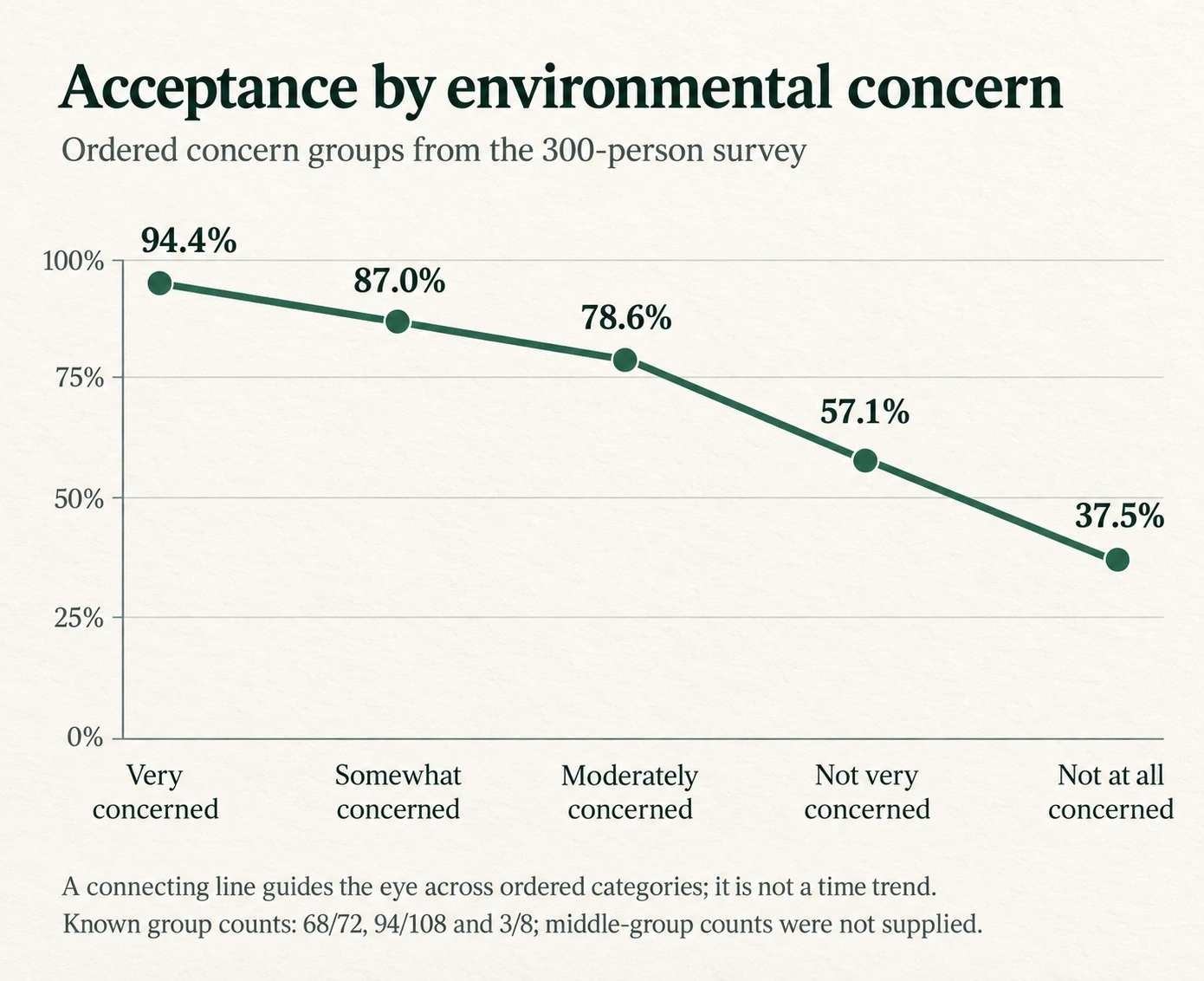
This set of data is very much worth discussing. Because it is exactly the opposite of a common assumption. We sometimes think: that the more radical and the more environmentally concerned people are, the more likely they are to reject a material once they know it still contains PP or ABS. But at least in this WOOYOPET survey, that did not happen.
It was precisely the group with the highest environmental concern that showed the highest acceptance of this route of “plants replacing part of the fossil-derived plastic”. This does not mean they do not want to reduce plastic further in the future. Very possibly the opposite. They are simply able to understand: The end point matters, but every kilogram reduced today matters just as much.
09 | Consumers are willing to support, but they do not lose their reason: environmental value cannot be a reason for unlimited price increases
Another very real question is price. If a product is noticeably more expensive than an ordinary product because it uses plant fiber, will consumers actually be willing to buy it? The answers from the 300 were not “I would pay anything for the environment”. They were, in fact, fairly restrained. The number of people unwilling to pay any premium at all for plant-fiber materials was 43, accounting for:
14.3%. In other words: 85.7%. of consumers were willing to accept some degree of price increase. But when broken down further, the genuinely mainstream range of acceptance is still concentrated at 0–10%. 91 people accepted a 0–5% premium, accounting for 30.3%. 102 accepted 5–10%, accounting for 34.0%. 48 accepted 10–20%, accounting for 16.0%.
Only 16 could accept a premium above 20%, accounting for 5.3%.
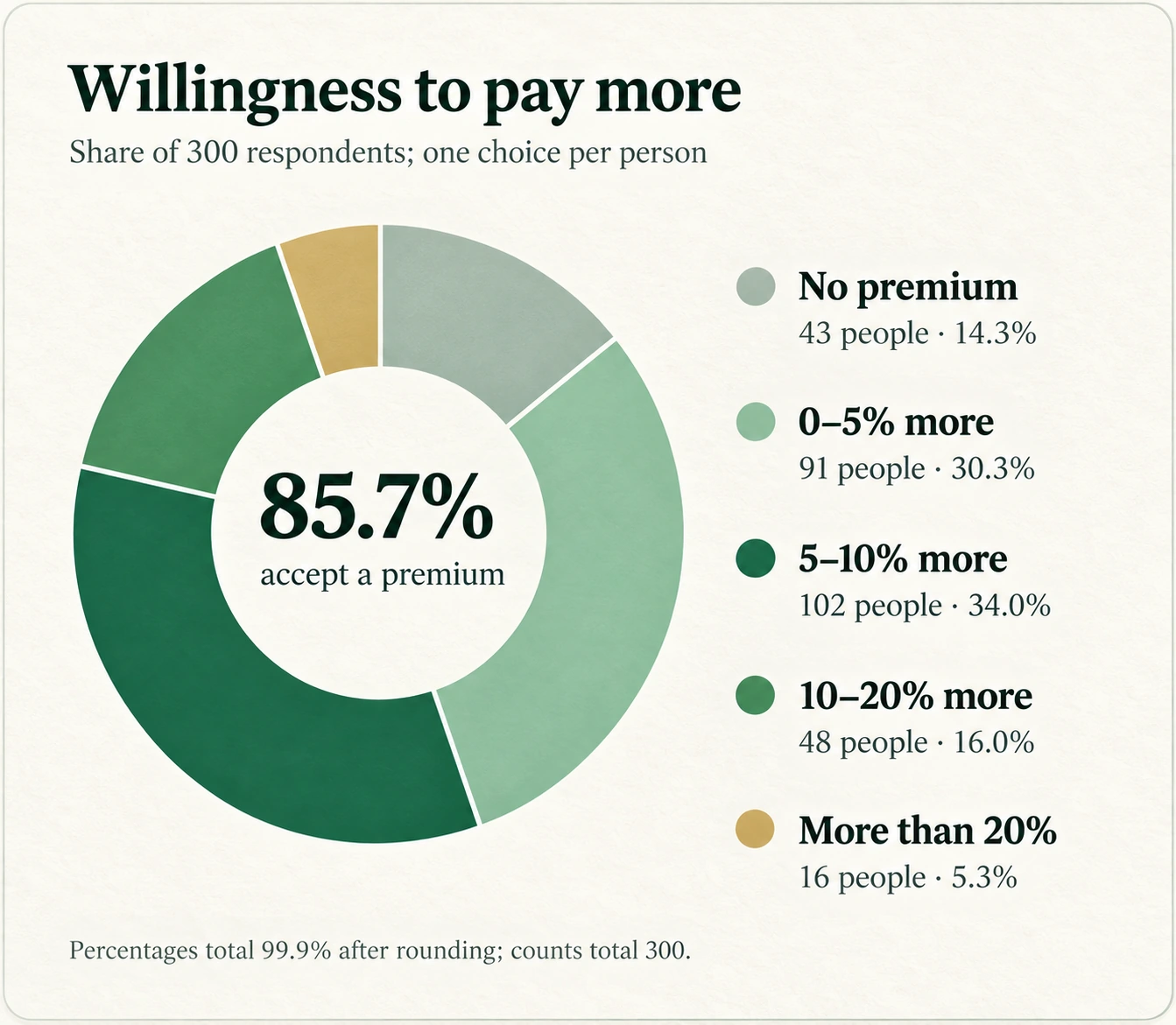
So consumers do not suddenly stop caring about price because they see the word “environmental”. They are still weighing things up. This, in turn, makes the survey results more real. Environmental value can generate willingness to pay, but that value has to be concrete enough. And precisely for this reason, information such as “25% plant content”, “32 g less plastic per item” or “made with recycled coffee grounds” matters more than an abstract green label.
Consumers need to know: what exactly the extra money they paid bought them.
10 | The top reason consumers choose plant-fiber products is not “it looks good” but “it really uses less plastic”
We also asked consumers to answer: If you are willing to choose plant-fiber composite products, what is the main reason? This was a multiple-choice question. The result that came first was: Reducing conventional plastic use — 221 people, or 73.7%. After that, in order: using natural plant resources — 186 people, or 62.0%; reusing agricultural/food by-products — 174 people, or 58.0%;
the environmental idea matching personal values — 162 people, or 54.0%; liking the specific material story of coffee grounds, rice husks and so on — 154 people, or 51.3%; the natural appearance looking better — 149 people, or 49.7%; being able to see plant fiber and feeling that it is special — 137 people, or 45.7%; feeling that the brand is more responsible — 132 people, or 44.0%;
the product story being more appealing — 118 people, or 39.3%. This result is very much worth brands reading carefully. Plant texture is of course important. A natural feel can of course increase a product’s appeal. And the material stories of coffee grounds and rice husks really do spread easily. But the first reason consumers gave was still not:
“It looks special.” It was: It really uses less conventional plastic. This may be the most fundamental difference between plant-fiber composites and purely “natural-style design”. If it were only about appearance, we could perfectly well dye plastic beige and print a few brown flecks on it. But what consumers genuinely support is:
that behind those flecks, part of the material’s source really has changed.
11 | It is not that the higher the plant ratio, the greener; what really matters is getting the reduction steadily into hundreds of thousands of products
Discussing plant-fiber materials makes it very easy to fall into another number contest: 20%. 30%. 40%. Whose plant content is higher? But in actual product development, we do not think this is a competition in which higher is always better. A litter scoop and a pet bowl need different material performance. An outdoor clip and an indoor base have different weathering requirements.
ABS systems and PP systems also face different processing problems. If chasing a beautiful “50% plant content” ends up making the product easy to break, noticeably shortening its service life, increasing production scrap rates, or making the product impossible to manufacture stably in volume, then that percentage is not as meaningful as it seems.
WOOYOPET prefers a different way of thinking: First ask what this product needs to accomplish, then ask how much of the fossil-derived material in it can reasonably be replaced. Sometimes it is 20%. Sometimes it is 28%. Sometimes it is 30%. What excites us more is not producing a specimen with an extremely high plant ratio in the laboratory.
It is: A 20% formulation that genuinely went into stable production of 500,000 products. Because that is what it means for material reduction to move from papers, concept samples and trade-show booths into the real world. Using less plastic should not mean products break sooner and are thrown away sooner. If a product can be used over the long term while reducing part of the fossil-derived polymer at the raw material stage, that change is more complete.
12 | What WOOYOPET wants is not to make plastic “look green”, but to bring plants into manufacturing for real
From fields, food-processing operations or timber-processing operations, a plant finally enters a pet feeding bowl, and in between there is in fact a very long distance. Coffee grounds cannot be poured straight into an injection molding machine. Nor do rice husks automatically become an industrial raw material. Plants need to be collected, screened, dried and milled.
Different materials need different particle sizes controlled. Moisture content has to be managed. A more stable interface needs to be established between the plant and the polymer. The material’s flow, impact performance, color, odor and surface effect all need to be readjusted. Only after that do they enter twin-screw equipment for compounding and pelletizing, followed by real injection molding validation.
Only when these steps are completed will “reusing agricultural by-products” stop remaining in a beautiful concept image. The position WOOYOPET really wants to occupy is the middle of this chain. At one end are natural plant sources such as coffee grounds, rice husks, wheat straw, wood fiber, bamboo fiber and coconut coir.
At the other end is modern industry, which still needs to manufacture large numbers of products stably every day. We hope that more and more designers, brands and manufacturing companies, when developing the next generation of products, will not only habitually ask: “What plastic are we using again this time?” But will be willing to ask one more question:
“Is there a part of this that does not actually have to be carried by oil?” This sentence looks very small. But if it starts to become part of the product development process, many things in the materials industry will slowly change.
Conclusion | Do not ignore the 25% we can already reduce just because we have not reached 100%
We certainly hope to see a future with lower dependence on fossil resources. A higher proportion of renewable materials. A more complete circular system. More mature bio-based polymers. Less single-use consumption. Longer product lifetimes. And even, in suitable areas, a complete break from fossil-derived plastic. All these goals are worth continuing to pursue.
But we are increasingly unwilling to accept another kind of logic: Because we cannot reach 100% today, a 20% reduction is meaningless. WOOYOPET’s survey of 300 consumers shows that 87.0% of respondents agreed: that even without being completely plastic-free, reducing plastic still has environmental meaning. Only 7.0% of valid answers insisted that as long as it still contains conventional plastic, it cannot count as an environmental improvement.
72.3% of consumers said that where performance is similar, they would be more willing to buy plant-fiber composite products. 80.3% want to know specifically how many grams less plastic each product uses. 78.9% consider such a number more credible than a phrase like “Eco-Friendly”. And among the group with the highest level of environmental concern, acceptance of plant-fiber composite plastic reached 94.4%.
These numbers do not tell us that plant fiber can solve all environmental problems. What they tell us is in fact a simpler thing: People are willing to support reductions that really happen. One pet feeding bowl uses 52 g less. One litter scoop uses 17 g less. One waste-bag dispenser uses 11 g less. One fountain base uses 44 g less.
Taken on their own, every one of these numbers is very small. But when five projects together displace about 37.4 tonnes of fossil-derived material in a year,. “small” has already started to become not so small. And if it becomes fifty kinds of products? Five hundred? If, in the future, more and more brands, when designing a product, all ask first:
“Is there a part of this plastic that no longer needs to be used?” then material transition may not happen at some sudden, great moment at all. It may happen like this: 100% becomes 80%. 80% becomes 70%. One product, a little less. After a million units,. a little is no longer a little. Less Plastic. More Plant. That is the change wooyopet wants to move forward.
About the WOOYOPET 2026 Consumer Survey
This survey was conducted by wooyopet around plant-fiber composites, consumer material preferences, awareness of fossil-derived plastic reduction, plant-source preferences and purchase intention. Valid samples: 300. Survey period: March–April 2026. Method: a mixture of an online questionnaire and offline sample testing, in which 96 people took part in physical sample testing and 204 took part in the questionnaire only.
Among respondents, 128 were male, 166 female, and 6 other or unwilling to disclose. The age structure was: 68 aged 18–24, 126 aged 25–34, 72 aged 35–44, and 34 aged over 45. The regional structure was: 236 in China, 22 in Japan, 18 in Southeast Asia, 16 in Europe and the Americas, and 8 in other regions. Of these, 214 respondents clearly stated that they had previously bought environmentally friendly or sustainable products, accounting for 71.3%; 52 said they had not, and 34 were uncertain.
The consumer percentages in this article are all calculated on the actual number of valid answers to each question, so the valid sample size for some questions is slightly below 300. The customer projects have been anonymized. The fossil-derived plastic displacement referred to in this article is calculated by mass from product weight, plant component ratio and actual or projected annual production quantity; it is used to illustrate the scale of material substitution and does not directly equal the same proportional reduction in carbon emissions.
Actual carbon emission changes still need to be assessed specifically in relation to plant source, original polymer type, processing energy, transport distance and life-cycle boundaries. wooyopet
Plant Fiber Composite Materials
Plant-fiber composites and fossil-plastic reduction research