
Coffee-Ground PP with a Degradation Additive for Golf Tees: A Case Analysis
A production-focused review of coffee-ground PP golf tees, including molding, regrind, additive control and defensible anaerobic-degradation verification.

Buyer and engineer FAQ
Questions buyers and molders ask about coffee-ground PP golf tees
Is coffee-ground PP biodegradable without an additive?
No. Its base polymer is PP. Coffee content changes the feedstock mix and appearance, but the finished tee needs a separate, validated end-of-life route before any degradation claim is made.
Does adding 1% degradation masterbatch prove more than 80% biodegradation?
No. One percent is a formulation starting point. The exact finished tee must be tested under a named standard, and the claim must state the measured percentage, duration and environment.
Why can the cup flash while the tee point remains incomplete?
Injection may be too fast at the cup while the mold is too cold for the long downstream point. Use a controlled speed profile, adequate mold temperature, venting and part-specific holding.
Can 30% production regrind be used in every golf tee?
Thirty percent worked in the documented 83 mm project, but regrind changes flow, stiffness, color and additive concentration. Validate the actual geometry and keep the regrind formulation traceable.
For a part-specific recommendation, share tee length, stem diameter, mold structure, regrind plan, target market and intended environmental claim with wooyopet.
The Golf-Tee Material Conflict
A golf tee has a short service life but a demanding use cycle. It must enter compacted turf without bending, support a ball at a consistent height and survive the lateral shock of a driver. After the shot, however, broken or forgotten tees can remain in the course, interfere with maintenance and become persistent plastic fragments.
Conventional PP provides predictable molding and adequate strength but is not inherently biodegradable. Pulp, bamboo and solid-wood tees can offer a different end-of-life route, yet their moisture sensitivity, grain variation and break behavior can make production and use performance less consistent. Coffee-ground-fiber PP offers a middle engineering route: a PP matrix for injection molding, processed spent-coffee particles for a recognizable brown appearance, and an optional degradation-additive formulation that can be evaluated under a defined anaerobic test condition.
This article follows two production projects—a standard 70 mm tee and an 83 mm extended tee—to explain the ready-compound data, drying and molding window, regrind blending, additive control and the evidence required before making a degradation claim.

1. P179506N Data Describes a Ready-to-Mold Compound
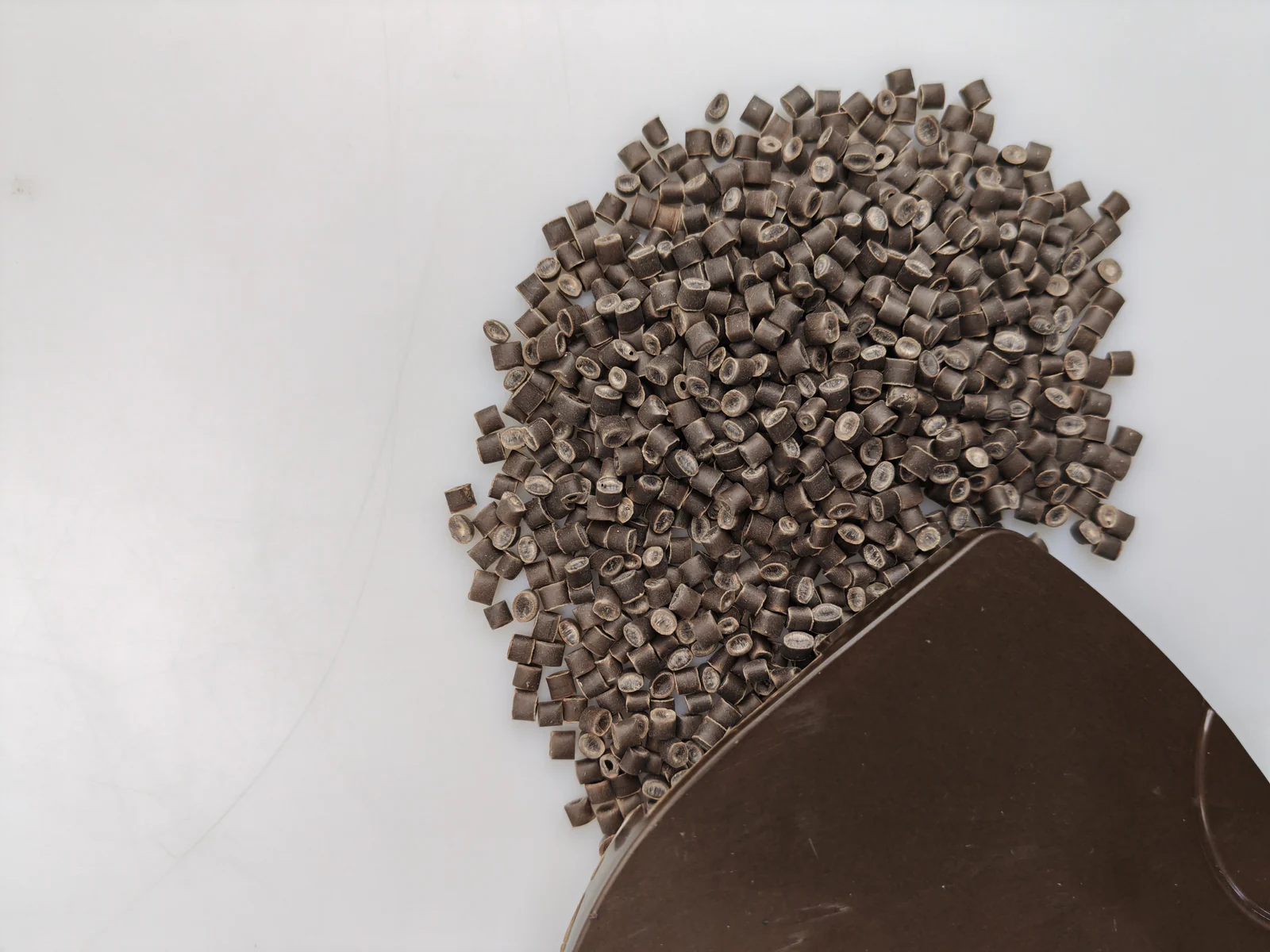
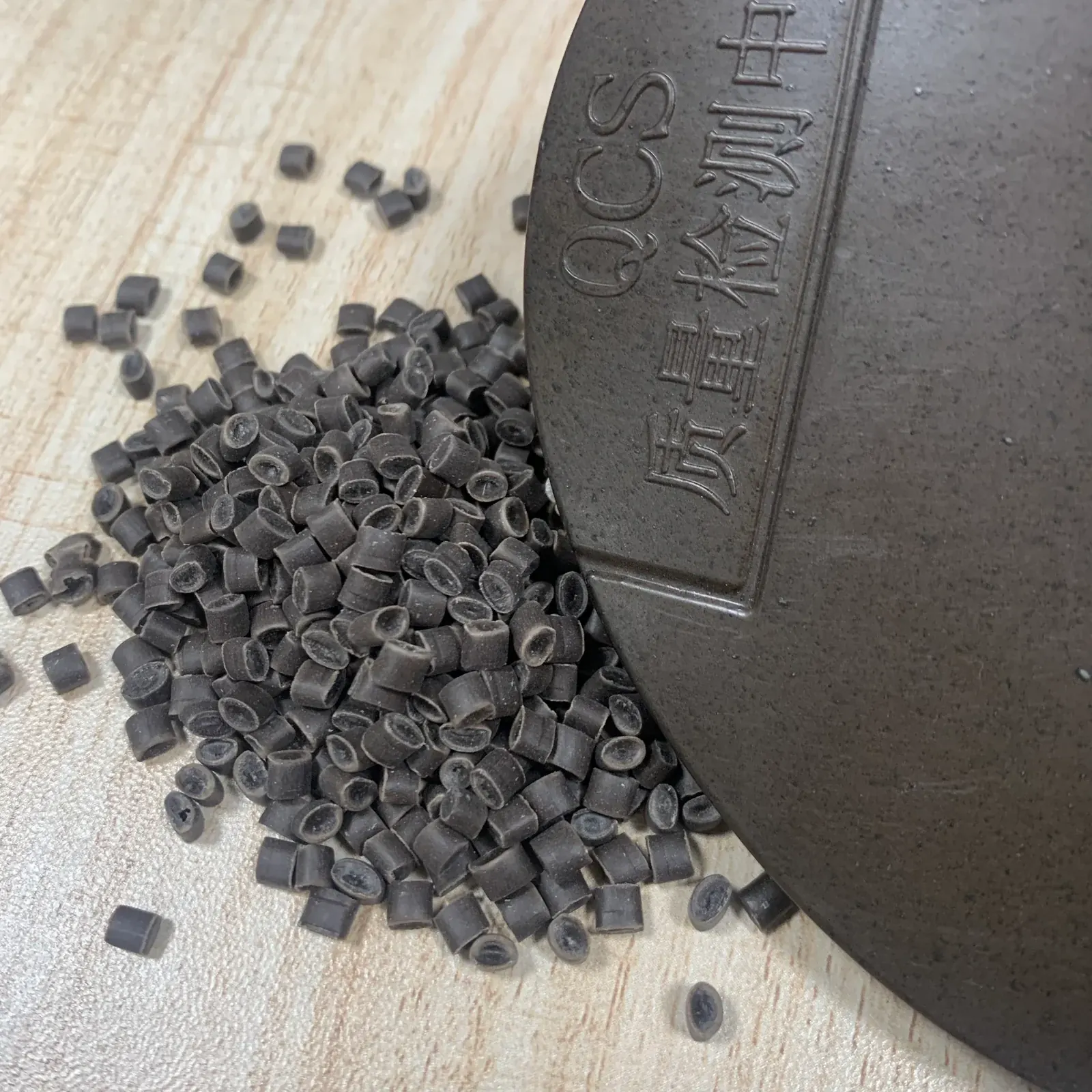
wooyopet WYC-PP P179506N combines polypropylene with processed spent-coffee fiber. The natural material is coffee brown, retains visible dark particles and may carry a mild roasted-coffee note depending on processing history. The figures below describe the coffee fiber at its ready-to-mold terminal concentration, not a high-concentration masterbatch before let-down.
That distinction changes machine setup. A concentrated masterbatch normally contains more plant material and may flow very differently from the approved production blend. Screw speed, pressure, cooling and dimensional compensation must therefore be based on the actual ready compound—or on the exact final formulation when pure PP, regrind or a degradation additive is introduced.
| Property | Typical Ready-Compound Value | Method / Condition |
|---|---|---|
| Material | PP + processed coffee-ground fiber | Natural coffee-brown injection compound |
| Density | 1.14 g/cm³ | ASTM D792 |
| Melt-flow rate | 13.5 g/10 min | 230°C / 2.16 kg |
| Molding shrinkage | MD 1.0%–1.2% | 2.0 mm specimen, machine direction |
| Tensile strength | 23 MPa | ASTM D638, 50 mm/min |
| Elongation at break | 4.6% | ASTM D638, 50 mm/min |
| Flexural strength | 40 MPa | ASTM D790, 10 mm/min |
| Flexural modulus | 1,250 MPa | ASTM D790, 10 mm/min |
| Notched Izod impact, 23°C | 3.6 kJ/m² | ASTM D256 |
| Shore hardness | 71.5 HD | ASTM D2240 |
| Heat-deflection temperature | 108°C | 0.45 MPa |
| Melting point | 170°C | Typical grade value |
| Drying | 100–120°C / 4–5 h | Dehumidified drying |
| Rear barrel | 155–165°C | Starting range |
| Middle barrel | 160–175°C | Starting range |
| Front barrel | 160–175°C | Starting range |
| Nozzle | 160–175°C | Starting range |
| Mold | 60–70°C | Starting range |
An MFR of 13.5 g/10 min gives P179506N more flow than the referenced P179302 wood-fiber PP at 7 g/10 min and P179002N grain-fiber PP at 9.5 g/10 min. That flow is useful for a tee’s long, slender stem and abrupt change from the cup to the point. The material still requires controlled speed and adequate mold temperature; nominal MFR cannot correct a frozen flow front, poor venting or an undersized gate.
The 23 MPa tensile strength is lower than P179302 at 32 MPa but higher than the referenced P179050 wheat-straw PP at 18 MPa. With 4.6% elongation and 3.6 kJ/m² notched impact performance, the grade is relatively rigid rather than ductile. Tee geometry must carry the lateral impact and insertion load without relying on high strain capability.
A 1,250 MPa flexural modulus gives the stem enough stiffness for insertion while retaining a less brittle response than a highly filled mineral compound. The 108°C HDT at 0.45 MPa is well above the normal turf-use temperature range, although outdoor approval must also consider UV exposure, moisture, thermal cycling and aging rather than HDT alone.
2. Coffee-Ground PP Is Not Inherently Biodegradable
The base polymer in P179506N is polypropylene. Adding coffee-ground fiber reduces the wholly petroleum-derived fraction and gives the material a recovered-feedstock component, but it does not make the PP matrix biodegradable. A golf tee molded from coffee-ground PP alone should not be described as biodegradable.
The project route adds an anaerobic-degradation additive to the final ready compound. A 1% addition was used as the starting formulation for the project trials. This percentage is a dosing and validation point—not proof of a particular degradation rate. The exact additive chemistry, dispersion, interaction with coffee fiber, regrind content and final tee geometry all affect the result.
What an Anaerobic Test Actually Demonstrates
ASTM D5511 and ISO 15985 evaluate plastics under high-solids anaerobic-digestion conditions using methanogenic inoculum and measurement of evolved biogas. The result is tied to the tested sample, duration and controlled laboratory environment. It should be reported as the measured rate and extent of conversion under those conditions, not converted into an unqualified claim that the product will disappear in any soil, landfill or golf course.
A course surface and root-zone soil are normally aerated and biologically different from a high-solids anaerobic digester. A fragment pushed deeper by maintenance is not automatically exposed to the moisture, inoculum, temperature and gas-management conditions used in ASTM D5511 or ISO 15985. The additive route therefore does not justify leaving tees on the course. Collection and responsible disposal remain the primary operating practice.
How to Handle the “More Than 80%” Target
The formulation target discussed for these projects was more than 80% anaerobic biodegradation under a specified test program. Until the exact final golf tee—including coffee-ground compound, 1% additive, color package and regrind ratio—has completed that program, 80% is a development target rather than a certified result.
A compliant report should identify the standard, final sample composition, test duration, inoculum, reference material, gaseous-carbon calculation and laboratory. Results must not be extrapolated beyond the test period or presented as evidence of degradation in a different environment.
For European projects, the additive mechanism must also be identified. Products made from oxo-degradable plastic are prohibited in the EU. A supplier should confirm that the route is not based merely on oxidation-driven fragmentation and should provide evidence of biological conversion rather than only molecular-weight loss, embrittlement or formation of smaller plastic particles.
3. Project One: Converting a Standard 70 mm Tee from Ordinary PP
The first customer molded a white 70 mm golf tee from commodity PP. Its impact and insertion performance were acceptable, but fragments left on the course persisted and could contact mower blades. The customer wanted a lower-impact material story without accepting bent stems, blunt points or fracture during a normal drive.
The First Trial Used Too Much Speed and Too Little Mold Heat
The original PP process used 80°C drying for one hour, a 190°C rear zone, 200°C middle zone, 205°C front zone, 200°C nozzle, 40°C mold and high-speed injection. For the first P179506N trial, the team assumed the 13.5 g/10 min MFR would support a relatively fast fill and set injection to medium-high speed.
The molded tees showed flash around the head while several points remained rounded and incomplete. The defect combination indicated an unstable filling strategy rather than insufficient bulk flow. Fast injection created an abrupt pressure rise at the cup, while the 40°C mold froze the slender downstream flow path before the point filled cleanly.
The team changed to dehumidified drying at 100°C for four hours, raised the mold to 60°C, reduced injection to low speed and increased holding pressure. The next trial filled the point and eliminated the cup flash, but faint gas marks and fine silver streaks remained along the stem.
Moisture Control Removed the Silver Streaks
Coffee-ground fiber absorbs more moisture than pure PP and may retain residual polar components from the feedstock. During injection, insufficiently dried material releases vapor that travels along the flow direction, creating silver streaks on the narrow tee stem.
Drying was extended from four to five hours and stabilized at 105°C in a dehumidifying dryer. The hopper and transfer path remained closed after drying. The stem surface became uniform and the gas marks disappeared without adding melt temperature.
Shrinkage Required a Dimensional Review
P179506N has an MD shrinkage range of 1.0%–1.2%, lower than many unfilled PP molding assumptions. The target stem diameter was 4.0 mm. Using a 1.0% development allowance gives an initial cavity dimension near 4.04 mm, but the final value must come from the real gate orientation, holding profile and measured parts.
The original tool had been compensated for the customer’s higher-shrinkage PP. Direct substitution produced an oversized stem. The customer molded three controlled batches, measured the diameter and straightness after conditioning and adjusted the cavity from the batch average instead of applying a generic PP shrinkage value.
Stable Standard-Tee Window
| Control | Stable Project Setting | Purpose |
|---|---|---|
| Drying | 105°C / 5 h, dehumidified | Remove moisture and prevent silver streaks |
| Rear zone | 165°C | Conservative feed-zone heat |
| Middle zone | 170°C | Uniform melting |
| Front zone | 175°C | Maintain tip filling |
| Nozzle | 172°C | Control drool and residence heat |
| Mold | 60°C | Keep the point flow path open |
| Injection speed | Low | Limit cup flash and unstable point flow |
| Holding | Moderately increased | Stabilize stem section and shrinkage |
Yield increased from 78% in the first trial to 94%. The final tees showed consistent coffee-brown color, a mild aroma, clean points and smooth insertion. No fracture occurred in the customer’s simulated strike screening. The exact chemical-safety and degradation claims for sale still depend on the approved final formulation and target-market test program.
4. Project Two: An 83 mm Extended Tee with Production Regrind
The second customer produced an 83 mm tee for driver shots. The longer, narrower stem increased flow length and bending demand. Cost was also critical, so the customer asked whether runner and rejected-part regrind from its own tee production could be returned to the formulation.
The Regrind Blend Ladder
Three controlled formulations were compared. Regrind came only from known P179506N tee production, was kept clean and was ground to a controlled particle range. Material from unknown products, mixed colors or other additive packages was excluded.
| Blend | Measured MFR | Flexural Modulus | Production Yield | Trial Result |
|---|---|---|---|---|
| 100% new P179506N compound | 13.5 g/10 min | 1,250 MPa | 94% | Reference formulation |
| 70% new compound + 30% controlled regrind | About 12.1 g/10 min | About 1,120 MPa | 91% | Accepted after strike and insertion screening |
| 50% new compound + 50% regrind | About 10.8 g/10 min | About 980 MPa | 85% | Several stems bent during insertion screening |
The 70/30 blend was selected. It reduced material cost by approximately 18% compared with the all-new compound while retaining acceptable filling, stiffness and project-level impact behavior. At 50% regrind, lower flow, lower flexural modulus and accumulated heat history narrowed the process window too far for the long stem.
Regrind size and dosing uniformity were important. Oversized flakes fed inconsistently and created visible shade variation. A controlled granulator screen, removal of dust and gravimetric dosing produced a more stable coffee-brown surface.
Additive Accounting with Regrind
The degradation additive must be calculated against the complete shot blend. If the regrind was generated from the same qualified additive-containing formulation, its additive history must remain traceable. If regrind came from a non-additive production run, adding 1% only to the new-material fraction would under-dose the final tee.
The approved production recipe therefore identified the additive percentage on total blend mass, segregated regrind by formulation and limited the number of heat histories. Any change in regrind ratio creates a new final composition and must be included in the degradation and mechanical validation plan.
Extended-Tee Process Adjustment
The 83 mm stem increased the flow path by almost 20% compared with the 70 mm tee. The 70/30 blend’s measured MFR of about 12.1 g/10 min was also lower than the new compound. Injection speed was raised from low to medium-low, mold temperature increased from 60°C to 65°C and the front zone moved from 175°C to 178°C. These modest changes preserved flow at the point without taking the complete melt outside the grade’s normal processing range.
Production yield stabilized at 91%. In the customer’s lateral-load screen, the 70/30 tee did not fracture under a 5 kg transverse load and performed close to the all-new formulation. The cost reduction was retained without using the 50% regrind level that had produced insertion bending.
5. Practical Injection-Molding Window for Golf Tees
| Control | Recommended Starting Point | What to Watch |
|---|---|---|
| Drying | 105°C / 5 h, dehumidified | Silver streaks, gas marks and hopper reabsorption |
| Rear zone | 165°C | Stable feeding without unnecessary heat |
| Middle zone | 170°C | Uniform melt and dispersion |
| Front zone | 175°C; up to 178°C in the extended-tee trial | Point filling and coffee-fiber scorching |
| Nozzle | 172°C | Drool, stringing and residence time |
| Mold | 60–65°C | Point fill, cycle time and stem deformation |
| Injection speed | Low to medium-low | Cup flash, jetting and incomplete point |
| Holding | Moderately increased | Stem sink, diameter and straightness |
| Regrind | Start at or below 30% | Flow, modulus, color, heat history and traceability |
| Degradation additive | 1% development starting point on total blend | Dispersion, mechanics and final-part test evidence |
Drying
Use dehumidified drying at 105°C for five hours as the golf-tee starting condition. Ordinary hot-air drying may be unstable during humid weather. Keep dried material in a closed hopper and transfer system; a narrow cosmetic stem makes moisture defects easy to see.
Melt and Mold Temperature
The successful project window used 165°C at the rear, 170°C in the middle, 175°C at the front and 172°C at the nozzle. Avoid solving every short shot with more heat. Excess temperature or residence time can darken and scorch the coffee particles, create black points and change odor. The product page’s broader starting limits are 155–165°C rear, 160–175°C middle/front/nozzle and 60–70°C mold.
A 60–65°C mold helped the slender point fill before freezing. Below that project window, the point became blunt or incomplete. Excessive mold heat lengthens cooling and can allow the stem to deform during ejection, so mold temperature must be tied to straightness and cycle-time measurements.
Injection Speed and Holding
Use low to medium-low speed. The cup fills early and can flash if the pressure rise is too abrupt, while the point still needs a stable advancing flow front. Tune the speed profile by cavity position where machine control allows it. Holding pressure and time should be based on gate seal, stem diameter and sink rather than simply copied from ordinary PP.
Regrind
Thirty percent was the accepted level for the extended-tee project, not a universal allowance. Regrind changes flow, fiber condition, color, additive concentration and degradation-test composition. Keep it segregated, clean and traceable; record its original formulation and number of heat histories.
6. Degradation Verification and Purchasing Questions
Procurement teams should request evidence for the exact finished tee, not only for an additive pellet or an unfilled PP reference. The report must match the production ratio, color package and regrind content. If a supplier presents a calculated degradation percentage, treat it as a formulation target until final-part testing is complete.
| Purchasing Question | Why It Matters | Acceptable Evidence |
|---|---|---|
| Is the claim aerobic, anaerobic, compostable or soil-degradable? | These are different environments and cannot be interchanged | Named standard and defined disposal environment |
| Was the test run on additive, resin plaque or finished tee? | Additive-only results do not prove finished-product performance | Exact final formulation and representative part |
| What does the percentage measure? | Mass loss, molecular-weight loss and gaseous-carbon conversion are not equivalent | Method, calculation, reference and raw endpoint |
| How long did the test run? | Results cannot be projected past the actual duration | Start/end dates and time-series data |
| Does the test match customary disposal? | A golf-course surface is not a high-solids anaerobic digester | Qualified claim limited to the tested environment |
| Is the chemistry oxo-degradable? | Oxo-degradable plastics are prohibited in the EU | Additive identity and biological-conversion mechanism |
| Was 30% regrind included? | Regrind changes the final formulation and additive dose | Report composition matching commercial production |
ASTM D5511 or ISO 15985 results can support a qualified statement about high-solids anaerobic-digestion performance. They do not prove that a tee will disappear quickly in surface soil, and they do not authorize a broad “biodegradable everywhere” claim. Marketing language should state the tested condition, percentage and duration with the same precision as the laboratory report.
7. Where P179506N Fits in the Coffee-Ground Material Range
P179506N is the injection-grade coffee-ground PP route for medium-wall molded products such as golf tees, daily-use goods, storage products and selected tableware concepts. Its 13.5 g/10 min MFR gives it a useful balance between flow and structure for a thin point and a thicker cup.
Coffee-ground ABS, such as the PA757-520 route, offers lower shrinkage and higher dimensional precision for housings and assembly-critical parts, but it uses a different resin, temperature window and end-of-life strategy. It should not be substituted directly into a PP tee tool without a full molding and performance review.
For a tee that prioritizes maximum stiffness, P179302 wood-fiber PP provides a 2,210 MPa flexural modulus and 4.5 kJ/m² notched impact value, but its 7 g/10 min MFR makes the slender point more demanding to fill. P179506N provides higher flow, moderate stiffness and a coffee-derived visual identity, making it the more practical starting point when molding efficiency, regrind use and coffee-feedstock storytelling are central requirements.
Conclusion
The standard-tee project showed that P179506N needs a warmer mold, thorough dehumidified drying and a slower, more controlled fill than the customer’s original PP process. The extended-tee project showed that 30% controlled production regrind could reduce cost while maintaining acceptable flow and stiffness, whereas 50% narrowed the process window and caused insertion bending.
The degradation-additive route must be handled with the same discipline. Coffee content is not proof of biodegradability, 1% additive is not proof of an 80% result, and a high-solids anaerobic test is not a simulation of every golf-course soil. The final commercial tee, with its exact additive and regrind composition, must be tested and marketed against the defined environment.
Teams developing coffee-ground PP golf tees can share the tee length, stem diameter, cup geometry, mold structure, regrind plan, target market and environmental-claim requirement with wooyopet for material samples and a part-specific validation route.