
Plant-Fiber Composite PE for Blow-Molded Bottles and Expanded Applications for Coconut-Coir PE Masterbatch
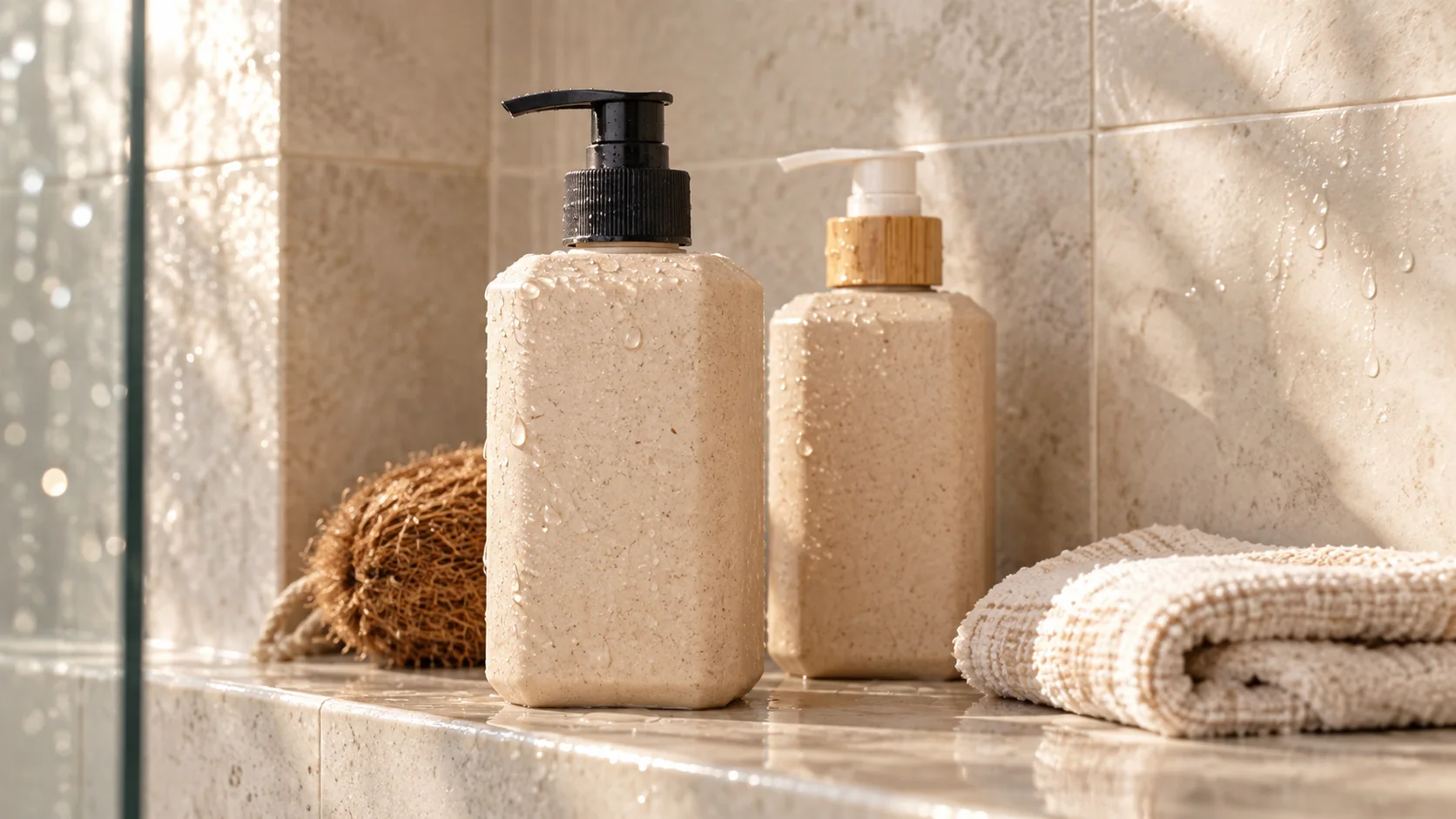
A 500 mL shampoo-bottle case and a high-fiber coconut-coir PE masterbatch show where ready-to-blow PE and adjustable injection formulations fit.
Buyer and engineer FAQ
Questions about plant-fiber PE for bottles and coconut-coir masterbatch
Why is a low MFR important for an extrusion-blow-molded bottle?
The hanging parison must retain enough melt strength to resist stretching under its own weight before the mold closes. A low MFR can support that requirement, but parison stability still depends on melt temperature, die-head design, residence time and the final formulation.
Can P179 WT020 run with the existing HDPE temperature profile?
The existing machine and mold can provide a trial starting point, but the ordinary-HDPE temperature profile should not be copied automatically. The documented plant-fiber PE window is lower, and excessive melt or die-head temperature can darken the fiber, reduce viscosity and increase parison sag.
Can YS60E be added directly to a blow-molding line?
YS60E is a 60% coconut-coir fiber PE masterbatch whose published processing route is injection molding after blending with compatible PE. Any blow-molding use requires a separate small-batch study of final fiber loading, MFR, melt strength, dispersion and bottle performance.
Does a 1:3 masterbatch-to-PE blend guarantee a specific modulus?
No. A 1:3 blend gives a theoretical fiber content of about 15% when the masterbatch contains 60% fiber, but final stiffness and impact behavior depend on the dilution PE, compatibility, moisture, dispersion and processing history. The finished blend must be molded and tested; wooyopet's published starting guidance recommends at least a 1:1 blend unless a project-specific trial supports another ratio.
For a part-specific recommendation, share the bottle volume, neck and shoulder geometry, target wall distribution, die-head and machine data, product contents, drop-test method and desired fiber appearance with wooyopet.
Why Blow-Molded Personal-Care Bottles Need a Different Plant-Fiber Strategy
HDPE bottles are used at enormous scale for shampoo, conditioner, body wash, household cleaners and cosmetic packaging. The reasons are practical: polyethylene has a proven extrusion-blow-molding route, good resistance to many formulations, useful drop performance and a supply chain familiar to packaging factories worldwide. At the same time, a package made entirely from conventional PE gives a brand limited room to discuss renewable or recovered feedstocks.
Plant-fiber composite PE offers an intermediate engineering route. A controlled amount of natural fiber is compounded into a PE matrix so that the bottle can retain the basic blow-molding process while gaining visible plant texture and reducing the wholly petroleum-derived share of the material. The route does not make the PE matrix inherently biodegradable, and it does not remove the need for compatibility, content-resistance, migration, drop and recycling assessments. Its value is the possibility of introducing a traceable plant component without abandoning a familiar bottle-forming process.
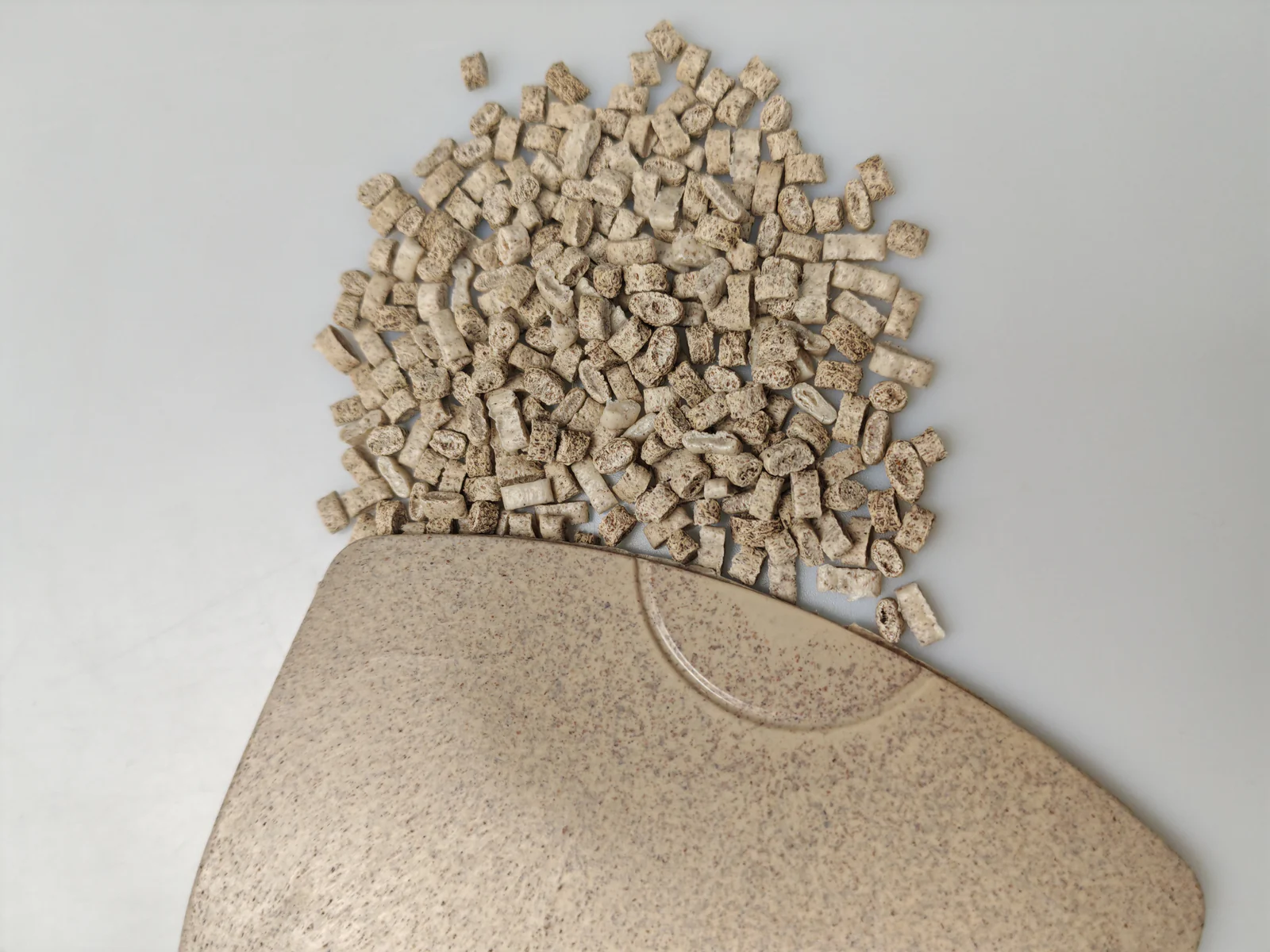
wooyopet has two PE-based materials that serve different jobs. WYC-PE P179 WT020 is a ready-to-process plant-fiber PE compound developed for blow molding. It has a low melt-flow rate and is intended to be fed as an approved terminal formulation. WYC-PE YS60E is a deep-brown, 60% coconut-coir fiber PE masterbatch. It is designed to be blended with compatible PE so an injection molder can adjust final fiber loading, color and stiffness for storage boxes, trays, housings and structural parts.
This article first follows a 500 mL shampoo-bottle project from ordinary HDPE to plant-fiber PE, including parison sag, longitudinal wall variation and surface texture. It then explains what the high-fiber YS60E masterbatch adds to the PE portfolio—and where its injection-molding data must not be treated as proof of blow-molding performance.
1. What the P179 WT020 Data Means for Blow Molding
P179 WT020 is identified as PE compounded with selected plant fiber. The natural material is pale, carries visible grain-like particles and may retain a mild plant note. Its low flow, high reported impact value and moderate modulus distinguish it from the injection-molding PP and ABS compounds elsewhere in the wooyopet range.
| Property | Typical Value | Method / Condition | Blow-Molding Relevance |
|---|---|---|---|
| Material | PE + plant fiber | Ready compound | Terminal formulation intended for direct processing |
| Density | 1.04 g/cm³ | ISO 1183 | Use for bottle-weight and material-consumption calculations |
| Melt-flow rate | 0.3 g/10 min | 230°C / 2.16 kg | Low-flow region associated with useful parison melt strength |
| Tensile strength | 24 MPa | ISO 527-2, 50 mm/min | Part of the bottle load and squeeze assessment |
| Elongation at break | 8.0% | ISO 527-2, 50 mm/min | Shows limited strain compared with neat flexible PE; geometry remains important |
| Flexural strength | 37 MPa | ISO 178, 10 mm/min | Relevant to panel feel and top-load response |
| Flexural modulus | 1,050 MPa | ISO 178, 10 mm/min | Moderate stiffness suitable for a squeezable bottle route |
| Notched Izod impact, 23°C | 16 kJ/m² | ISO 180/1U | Supports drop-resistant development but does not replace a filled-bottle drop test |
| Shore hardness | 65 HD | ISO 868 | Useful for comparing surface feel between approved batches |
| Melting point | 135°C | Grade reference | Processing temperature must still provide complete, uniform plasticization |
The 0.3 g/10 min MFR Is a Process Clue, Not a Complete Recipe
An injection-molding plant-fiber PP may report an MFR in the 7–15 g/10 min range. A blow-molding PE at 0.3 g/10 min operates in a very different flow region because the extrusion process requires the hot parison to hang unsupported before it is enclosed by the mold. If melt strength is too low, gravity stretches the parison, its upper region becomes thin and the lower region accumulates material.
The low MFR is therefore consistent with the intended process, but it cannot guarantee stable parison behavior by itself. Melt temperature, die swell, head design, extrusion rate, fiber dispersion, moisture and residence time all change the way the parison hangs. Incoming MFR is best used as one consistency check under the same test method and condition.
Impact Strength Must Be Confirmed on the Filled Bottle
The reported 16 kJ/m² notched Izod result is high relative to many rigid plant-fiber injection compounds. It indicates that the tested formulation retains a useful impact response, which is valuable for a bottle that will be filled, capped, packed, transported and dropped. A molded test-bar result is not the same as bottle performance. The bottle’s base pinch-off, shoulder transition, handle or grip geometry, wall distribution and contents determine where stress concentrates during a drop.
For that reason, the project described below used filled-bottle drops after the wall-thickness program was stabilized. The material data selected the development route; the bottle test approved the actual package.
Moderate Modulus Is Appropriate for a Bottle
A flexural modulus of 1,050 MPa is below the 2,000 MPa-plus values reported for some wood- and bamboo-fiber PP grades. That is not a weakness in this application. A shampoo bottle does not need the stiffness of a chew toy or a snap-fit electronics shell. It needs controlled squeeze, recovery, impact tolerance and a stable wall. Increasing stiffness without checking pinch-off strength and squeeze behavior could make the package feel brittle or difficult to dispense.
2. Blow Molding Exposes Different Plant-Fiber Problems
Injection molding and extrusion blow molding do not stress a compound in the same way. An injection part is filled under pressure inside a closed cavity. A blow-molding parison is extruded into open air, hangs under its own weight, is pinched by the closing mold and is then expanded against the cavity by air pressure. Plant fibers can influence every stage.
Parison Sag
If melt temperature is too high or the final formulation lacks melt strength, the parison lengthens before the mold closes. The resulting bottle can become thin at the shoulder and heavy at the base. Plant fiber may raise low-shear viscosity in one formulation yet create local instability in another if moisture, dispersion or concentration is uncontrolled. The practical answer is not “more fiber” or “less fiber” in isolation; it is a stable final compound, a controlled melt temperature and a programmed parison profile matched to the bottle.
Longitudinal Wall-Thickness Variation
The fiber and PE matrix do not transfer heat identically. Nonuniform fiber distribution can therefore amplify temperature differences across the parison. Blow-up ratio, mold venting, cooling and the shoulder-to-body transition also influence where the material stretches. Unlike an injection-molded shrinkage correction, the blow-molding engineer must manage the thickness of the parison before inflation and the local stretch after it reaches the mold.
Visible Grain and Surface Roughness
Plant particles can become more visible when the parison is stretched. A fine, even grain may create the natural matte appearance a brand wants; coarse or poorly dispersed material may appear as rough streaks or exposed particles. The accepted appearance must be defined with a real blow-molded bottle, because an injection plaque does not reproduce the same stretch ratio or surface development.
Fiber Content Versus Process Stability
Higher plant-fiber content can strengthen the renewable-feedstock story, but it also changes melt rheology, surface appearance, impact behavior and recyclability. P179 WT020 is supplied as a ready formulation so the fiber level, carrier and process response are controlled together. If a factory later dilutes it with HDPE to soften the appearance, the new blend becomes a different material and must be revalidated.
3. Project: Converting a 500 mL Shampoo Bottle from Ordinary HDPE
The customer produced 500 mL shampoo and conditioner bottles from natural HDPE with a pressure-sensitive label. The brand wanted a visible plant-material feature while keeping the existing extrusion-blow-molding line and achieving drop performance comparable to its established bottle. The bottle had a softly squared body, defined shoulder and a wall distribution already optimized for the ordinary HDPE grade.
First Trial: Copying the HDPE Profile Caused Sag and Darkening
The original HDPE process used barrel temperatures of 180°C rear, 195°C middle and 210°C front, with a 205°C die head. Screw speed was medium, inflation pressure was 0.5 MPa and mold temperature was 15°C.
On the first plant-fiber trial, the high front-zone and head temperatures reduced melt viscosity and increased the material’s heat exposure. The parison color became darker and a light scorched odor appeared. More importantly, the parison stretched rapidly before mold closure. Finished bottles showed a longitudinal wall difference above 0.4 mm: the lower region was heavy while the shoulder was too thin.
The defect was not evidence that the machine could not run the compound. It showed that an ordinary-HDPE heat profile was unsuitable for the lower plant-fiber PE processing window.
Lower Temperature, Lower Screw Speed and a New Parison Program
The barrel was reset to 168°C rear, 172°C middle and 178°C front. Die-head temperature fell from 205°C to 180°C. These settings sit inside the supplier’s barrel guidance and keep the head near the development window of approximately 175–185°C. The lower melt temperature improved parison shape retention and removed the scorched note.
Extrusion rate slowed after the temperature reduction, and a light rough pattern appeared when material stayed too long in the head. Screw speed was moved from medium to medium-low to limit shear heating, while machine timing was adjusted so the interval between parison extrusion and mold closure remained short and consistent. The goal was controlled output, not simply the lowest possible speed.
Inflation pressure was reduced from 0.5 MPa to 0.45 MPa after several trials. At the original pressure the shoulder stretched too aggressively; at a substantially lower pressure, local wrinkles and incomplete surface definition appeared. The 0.45 MPa setting provided the best result for this specific 500 mL mold and should be treated as a case value, not a universal pressure for every bottle.
Programming Wall Distribution
Temperature correction reduced sag but did not completely equalize the longitudinal wall. The parison wall-distribution system was therefore reprogrammed with more material in the section destined for the upper bottle and less in the section destined for the lower body. This “upper-thick, lower-thin” preform profile compensated for the remaining gravitational stretch.
Measurements were taken at the base, lower sidewall, center panel, shoulder and neck transition across multiple cycles. The team adjusted the program in small increments until the shoulder no longer fell below the customer’s minimum while the base remained within the weight target.
The Brand Chose to Keep the Natural Grain
The stretched plant fiber created a more visible granular texture than the customer’s ordinary HDPE. Three appearance routes were reviewed: the natural formulation, a color-masterbatch version that masked part of the grain, and a mold-frosted version. The brand selected the natural surface because the particles made the material change immediately recognizable. This was an aesthetic approval, not a general rule. Another cosmetic line may require a finer fiber, lower loading or a controlled color package.
Drop Test and Stable Production
After wall distribution was stabilized, three production batches totaling 30 bottles were filled with 500 mL of water and dropped from 1.2 m onto concrete. No bottle fractured, and the base pinch-off and shoulder transition remained intact. The test supports this bottle, process and sample set; production approval should retain the customer’s conditioning, closure orientation and pass criteria.
Stable case settings were 168°C rear, 172°C middle, 178°C front and a 180°C die head, with medium-low screw speed, 0.45 MPa inflation pressure and a 15°C mold. Yield rose from 81% in the first trial to 94%. The customer then applied the route to both 500 mL shampoo and conditioner bottles. A thinner body-wash bottle remained under evaluation because its narrower wall window required a separate parison program and drop validation.
| Shampoo-Bottle Item | Original HDPE Setup | Stable Plant-Fiber PE Direction | Observed Result |
|---|---|---|---|
| Rear / middle / front | 180 / 195 / 210°C | 168 / 172 / 178°C | Reduced heat exposure and improved parison viscosity |
| Die head | 205°C | 180°C | Reduced sag, darkening and scorched odor |
| Screw speed | Medium | Medium-low with controlled timing | Limited shear heat while avoiding long head residence |
| Inflation pressure | 0.5 MPa | 0.45 MPa | Better shoulder thickness for this bottle |
| Mold temperature | 15°C | 15°C | Existing cooling condition retained |
| Parison program | Ordinary-HDPE profile | More upper-section material, less lower-section material | Compensated for gravitational stretch |
| Yield | 81% at first plant-fiber trial | 94% | After temperature, timing, pressure and wall programming |
4. YS60E: A High-Fiber Coconut-Coir PE Masterbatch
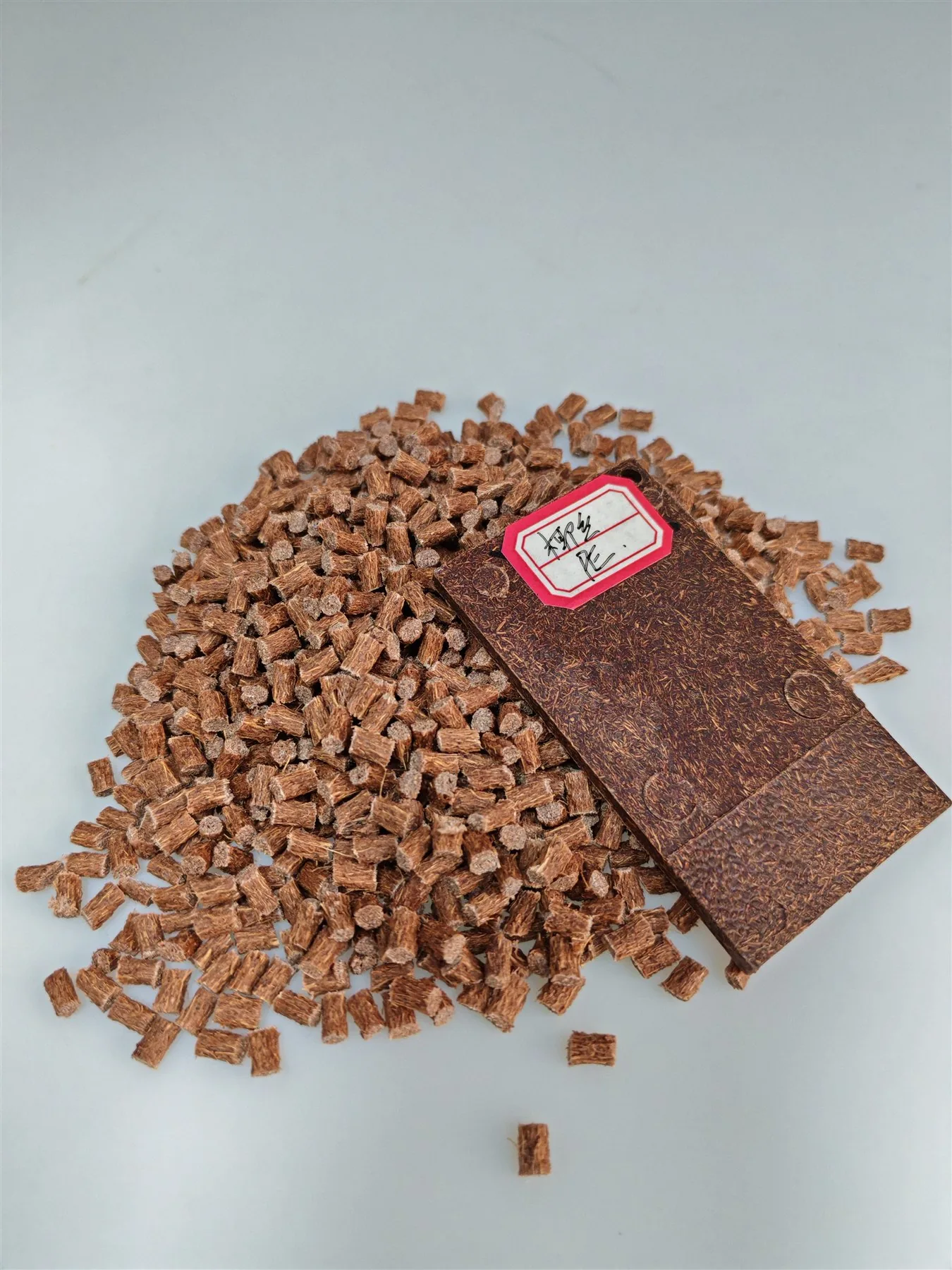
YS60E is not the same product route as P179 WT020. It is a deep-brown PE masterbatch containing 60% processed coconut-coir fiber. It gives a downstream factory a concentrated feedstock that can be blended with compatible PE, allowing the final fiber visibility, brown tone and stiffness to be tuned for an injection-molded product.
Coconut coir comes from the fibrous layer around the coconut shell. Its coarse, tough morphology creates a strong visible identity in a composite, but that same morphology requires controlled drying and dispersion. The published values below describe the masterbatch material, not every possible diluted formulation.
| YS60E Masterbatch Property | Published Value | How to Use the Number |
|---|---|---|
| Plant-fiber content | 60% | Calculate theoretical final fiber content from the actual blend ratio |
| Color / form | Deep-brown pellets | Expect a lighter brown as compatible PE is added |
| Intended process | Injection molding after blending | Do not assume blow-molding suitability |
| Tensile modulus value | 40 MPa | Published label value; confirm terminology and method on the current data sheet |
| Elongation at break | 4.8% | Masterbatch test value, not diluted-part elongation |
| Elastic modulus | 1,300 MPa | Masterbatch data under the reported method |
| Flexural strength | 82 MPa | Masterbatch value; final blend must be retested |
| Flexural modulus | 4,400 MPa | Shows high stiffness in concentrated form, not final-part performance |
| Notched impact, 23°C | 3.9 kJ/m² | Use only for the tested masterbatch formulation |
| Density | 1.17 g/cm³ | Final blend density changes with dilution PE |
| Melt index | 3.18 | Confirm the test condition before comparison with another resin |
| Hardness | 82 | Confirm scale and current data sheet for specification use |
Why the Masterbatch Model Is Useful
A fixed ready compound provides convenience but locks the factory into one fiber level and one property balance. A 60% masterbatch gives the development team more room. A thick storage box may use a higher loading for stronger texture and stiffness, while a thinner tray may need more dilution to improve flow and impact behavior. The same concentrated material can support several final formulations if each is controlled and validated separately.
The theoretical fiber-content calculation is straightforward. A blend of one part YS60E and three parts pure PE contains approximately 15% fiber because one quarter of the blend is masterbatch and 60% of that quarter is fiber. The mechanical result is not equally simple. Modulus, strength and impact do not necessarily move in a straight line with blend ratio. Carrier compatibility, dilution-PE molecular weight, fiber wetting, moisture and shear history can produce nonlinear changes.
wooyopet’s current product guidance recommends blending YS60E with compatible pure PE at a minimum ratio of 1:1. A lower masterbatch share such as 1:3 is therefore a development formulation that should be confirmed with the supplier and validated through molding and physical testing before production. The calculation can define what to test; it cannot replace the test.
Color Is Part of the Formulation
The deep-brown pellets become lighter brown or beige-brown as natural or light PE is added. This can remove the need for an additional color masterbatch when the brand wants a natural coir appearance. If a specific tone is required, prepare a dilution ladder, mold plaques and the actual part, then approve color under one light source and measurement method. Below approximately 10% final fiber, the texture and reinforcing effect may become too subtle for the intended product story, but the practical threshold depends on the part and base resin.
Why YS60E Is Not Automatically a Blow-Molding Additive
The published processing route for YS60E is injection molding. Its high fiber concentration and 3.18 melt-index value describe the masterbatch, not the final diluted blend and not a hanging parison. Adding it to a blow-molding HDPE changes MFR, low-shear melt strength, die swell, surface, pinch-off fusion and wall distribution simultaneously.
A blow-molding extension is possible only as a controlled development project. Define the final fiber target, select a compatible blow-molding PE, dry both components, compound or mix them consistently, and measure the final blend’s MFR and rheological behavior. Then evaluate parison stability, bottle weight, wall map, pinch-off, environmental stress cracking, contents compatibility and drop performance. Until that work is completed, P179 WT020 remains the direct starting point for blow-molded hollow packaging.
5. Selection Boundaries Between the Two PE Routes
| Application | Preferred Starting Material | Reason | Required Validation |
|---|---|---|---|
| Shampoo, conditioner and body-wash bottles | P179 WT020 | Ready blow-molding compound, 0.3 g/10 min MFR and 16 kJ/m² impact value | Wall map, filled-bottle drop, contents and closure compatibility |
| Cosmetic or household hollow container | P179 WT020 | Low-flow PE route with natural matte grain | Surface limit, stress cracking, color and label adhesion |
| Injection-molded storage box or tray | YS60E + compatible PE | High-fiber masterbatch allows controlled dilution | Final blend flow, stiffness, impact, shrinkage and color |
| Rigid injection housing with strong coir texture | YS60E at a validated higher loading | Concentrated fiber and deep natural color | Gate, weld line, fiber dispersion and cosmetic standard |
| Experimental blow-molding blend | YS60E only within a development program | Can tune fiber source and content but lacks ready blow-molding approval | Final-blend rheology, parison, pinch-off, wall and drop testing |
| Food-contact packaging | Confirm the exact grade and report | Food-contact status is formulation- and market-specific | Applicable migration and compositional compliance for the final article |
Food-contact documents for a different wooyopet PP grade do not automatically apply to these PE grades. A buyer should obtain the report for the exact PE formulation, color package and intended conditions of use. Cosmetics and household chemicals also require contents-compatibility work even when the package is not regulated as a food-contact article.
6. Common Blow-Molding Defects and a Practical Check Order
| Defect | Likely Process Areas | Recommended Check Order |
|---|---|---|
| Parison sag; top thin and base heavy | Head temperature, melt strength, extrusion timing, parison program | Lower excessive head temperature, stabilize output and closure timing, then reprogram wall distribution |
| Rough parison or scorched odor | Heat history, residence time, dead spots, moisture | Review every barrel/head sensor, purge, shorten residence and verify drying |
| Local thin wall after inflation | Pressure, blow-up ratio, parison temperature, shoulder geometry | Map wall thickness, adjust pressure and parison profile, then review geometry |
| Excessive visible particles | Fiber size, loading, dispersion, stretch ratio | Approve a real bottle; if rejected, trial controlled dilution or a finer-fiber formulation |
| Wrinkles or incomplete cavity definition | Low pressure, cold parison, venting | Confirm pressure and melt window, clean vents, then evaluate tool changes |
| Drop fracture at shoulder or base | Thin wall, pinch-off design, local stress, contents and conditioning | Inspect the wall map and fracture origin before changing the material |
| Unstable color or odor | Fiber lot, moisture, residence, regrind | Control incoming lots and drying, limit residence, isolate regrind trials |
A blow-inflation pressure of approximately 0.4–0.5 MPa can be a useful starting region for the documented class of bottle, but the correct value depends on volume, wall, blow-up ratio and mold. Likewise, a mold-vent depth around 0.025–0.038 mm with a land width of at least 1.5 mm can be evaluated as an initial tooling reference, not copied blindly. Excessive vent depth creates flash; insufficient venting traps air and weakens surface definition.
7. The Role of PE-Based Plant-Fiber Materials in the wooyopet Portfolio
wooyopet’s PE line currently represents two complementary development directions. P179 WT020 is the ready blow-molding route: low MFR, useful impact behavior, a 165–180°C barrel reference range and a natural plant-grain surface for hollow packaging. YS60E is the high-concentration masterbatch route: 60% coconut-coir fiber, deep-brown appearance and a reported 4,400 MPa flexural modulus in masterbatch form, intended for controlled blending and injection-molded parts.
For a bottle project, the distinction prevents wasted trials. Select P179 WT020 when the immediate goal is extrusion blow molding. Select YS60E when an injection molder needs adjustable fiber content and a strong coconut-coir identity. Treat a YS60E blow-molding formulation as a new material-development project rather than as a simple dosing change.
The shampoo-bottle case also shows why plant-fiber packaging succeeds or fails at the process level. The first trial produced sag and a 0.4 mm-plus wall difference because the ordinary-HDPE heat profile was too aggressive. Stable production required a lower barrel and head profile, controlled screw speed, part-specific inflation pressure and a new parison-thickness program. Once those variables were aligned, the line reached 94% yield and the filled bottles passed the documented 1.2 m drop series.
A credible plant-fiber bottle is therefore more than a pale bottle with visible speckles. It is a defined final formulation, a stable parison, a measured wall map and a package that withstands its contents, filling line, distribution route and use cycle. That combination is what lets a brand introduce plant material without trading away the performance that made HDPE bottles successful in the first place.