
Wood-Fiber Composite Materials Developed for Pet Products: Suitable for Pet Toys and Chew Sticks
How pine wood fiber, interface design, part geometry and a controlled molding window shaped two production pet-toy projects.
Buyer and engineer FAQ
Questions engineers ask before molding P179302 pet products
Can P179302 use the same 200–210°C settings as ordinary injection PP?
No. Start within the grade window: 165–175°C in the rear and middle zones, 175–185°C in the front zone and nozzle, and a 70–80°C mold. Excessive heat or residence time can scorch the wood fiber.
Is 73 HD hardness enough to approve a finished chew toy?
No single material value approves the product. Validate size, wall section, radii, bite-force range, flex, fragment retention and supervised use with the final molded geometry.
Why does a rope hole crack even when the material data is strong?
Rope holes concentrate stress and often contain a weld line. Review local wall thickness, radius, gate position, venting and holding before changing the material.
What causes black specks, darkening and burnt pine odor?
The common causes are excessive melt temperature, long residence time, incomplete purging and high regrind heat history. Return to the grade-specific window and stabilize drying before changing several variables.
For a part-specific recommendation, share the drawing, wall thickness, gate position, target dog size, use environment and current process with wooyopet.
1. The Material Background of P179302
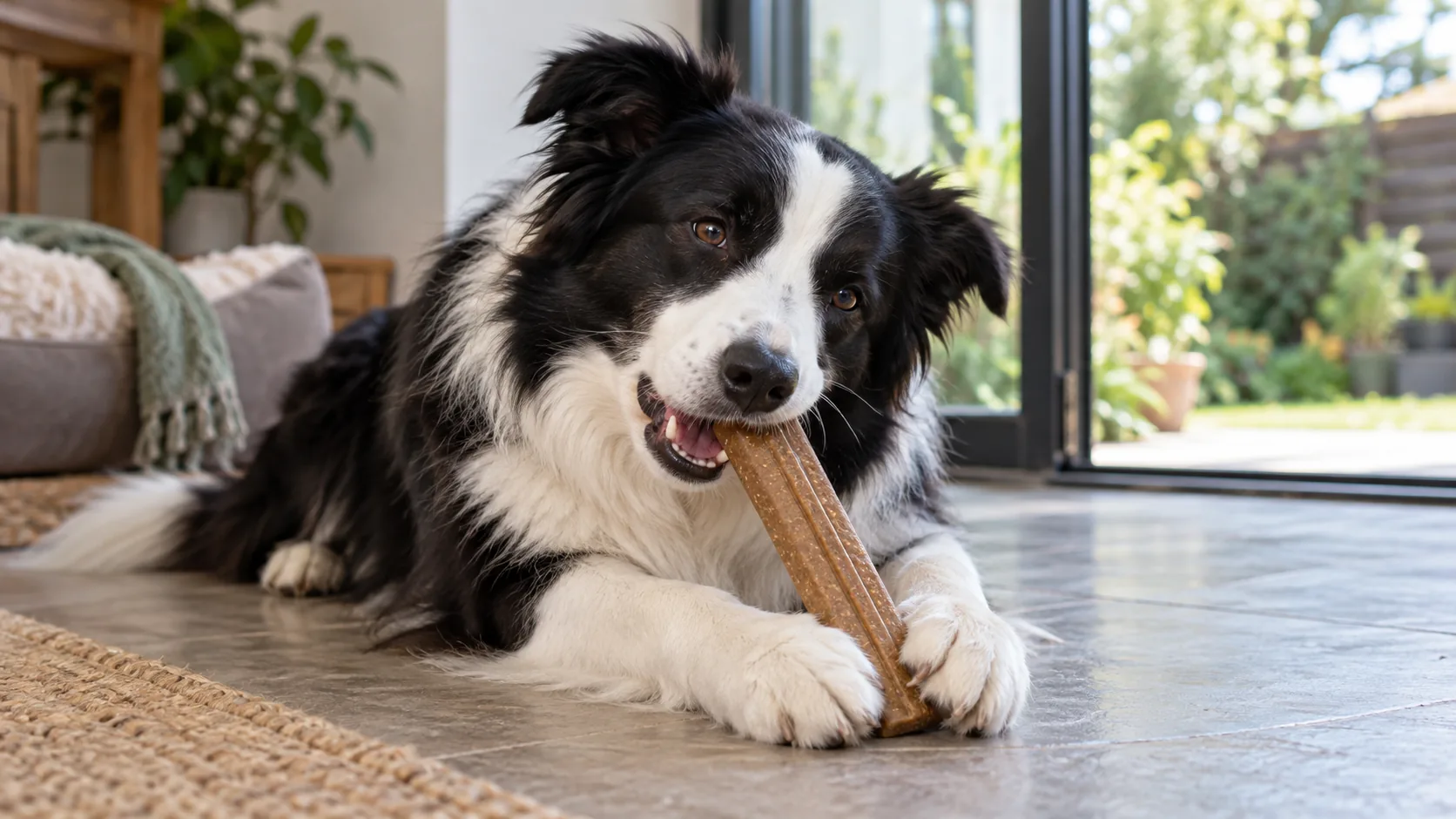
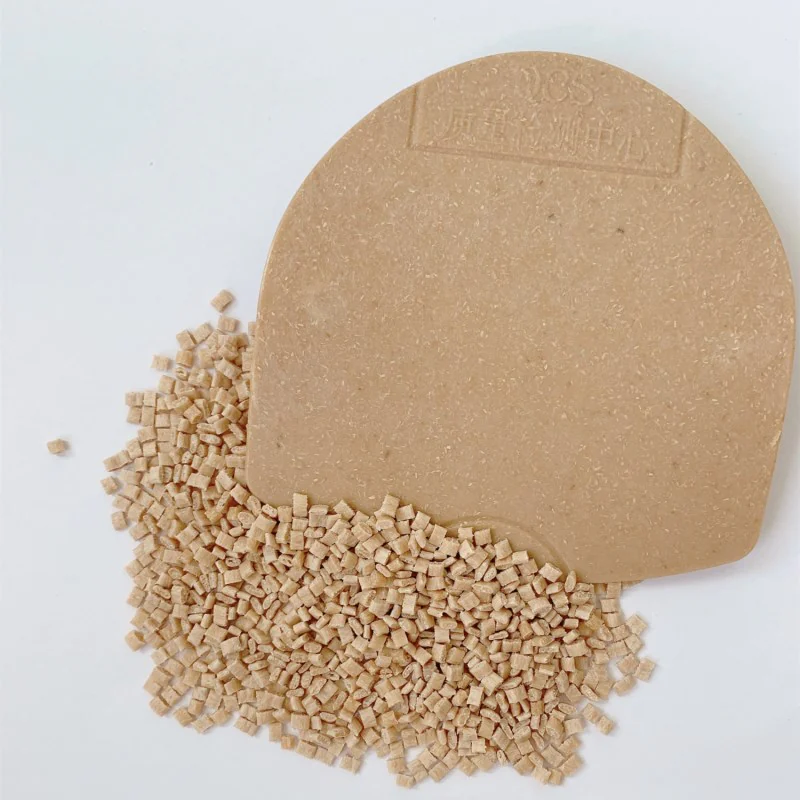
wooyopet WYC-PP P179302 is a natural-color polypropylene compound made with pine-derived wood fiber. Molded parts retain visible wood particles and a mild pine aroma, while the PP matrix provides the processability and moisture resistance required for practical pet products. The grade was developed for molded components that need a firmer bite response, natural surface character and better dimensional stability than a conventional appearance-only PP compound.
Why Pine Wood Fiber Is Used for Pet Products
Pine is a softwood built largely from long, slender tracheid cells. Once the fiber has been dried, refined and dispersed through PP, its geometry helps create a reinforcing network inside the molded part. That network raises stiffness, gives the surface fine natural texture and changes the way the part feels and sounds during contact.
The objective is not to imitate a raw branch. A pet chew made from P179302 is a molded composite with controlled geometry, rounded edges and a continuous polymer matrix. The visible wood fiber gives the product a warmer, less conventional-plastic appearance, while the natural pine note can improve product identity without relying on a strong added fragrance.
For chew products, however, fiber choice is only one part of the design. Product size, wall thickness, radius, bite-force range, retention of chewed fragments and the amount of flex under compression must all be validated on the finished toy. A Shore hardness number is useful for comparing molded materials, but it is not by itself a dental-safety certification. The finished product should be matched to the dog’s size and chewing behavior and used under supervision.
Wood Fiber and PP Need an Engineered Interface
Wood fiber is hydrophilic and polar; polypropylene is hydrophobic and non-polar. Directly mixing untreated wood fiber into PP produces weak interfacial adhesion, inconsistent dispersion and poor stress transfer. The visual analogy is sand suspended in adhesive: the particles may be present, but they do not reinforce the matrix efficiently.
P179302 uses a compatibilization strategy based on maleic-anhydride-grafted polypropylene. The polar functional groups interact with hydroxyl-rich wood surfaces, while the polypropylene segments remain compatible with the PP matrix. This bridge improves fiber wetting, dispersion and interfacial stress transfer, supporting higher tensile and flexural properties than an untreated wood-powder blend. A compatible toughening phase balances the added stiffness so the finished part can absorb impact instead of behaving like a brittle, mineral-filled molding.
This interface design matters during chewing and impact. When the dog compresses the toy, load must move from the PP matrix into the fiber network without opening weak gaps around the fibers. During a drop or tug event, the matrix must also retain enough toughness to prevent a local notch from turning into a fast crack.
Typical P179302 Grade Data
| Property | Typical Value | Test Method / Direction |
|---|---|---|
| Material | PP + pine wood fiber | Natural-color ready compound |
| Density | 1.11 g/cm³ | ASTM D792 |
| Melt-flow rate | 7 g/10 min | Typical grade value |
| Tensile strength | 32 MPa | ASTM D638, 50 mm/min |
| Elongation at break | 5.0% | ASTM D638, 50 mm/min |
| Flexural strength | 47 MPa | ASTM D790, 10 mm/min |
| Flexural modulus | 2,210 MPa | ASTM D790, 10 mm/min |
| Notched Izod impact, 23°C | 4.5 kJ/m² | ASTM D256 |
| Shore hardness | 73 HD | ASTM D2240 |
| Molding shrinkage | MD 0.8%–1.1% | Machine direction |
| Melting point | 160°C | Typical grade value |
The 2,210 MPa flexural modulus gives P179302 a firm structural response, while 32 MPa tensile strength and 4.5 kJ/m² notched impact strength provide a more balanced profile than a highly rigid but brittle appearance compound. The 5% elongation shows that the material is not rubber-like; geometry and local wall design remain essential for controlling strain.
At 1.11 g/cm³, the material is denser than conventional unfilled PP. That additional mass can give a chew stick a more substantial hand feel, but it also affects shot weight and unit-cost calculations. The MD shrinkage range of 0.8%–1.1% is useful for rope holes, locking features and paired components where dimensional drift directly affects assembly.
What Was Balanced for Chew-Durable Parts
Chew durability is not achieved by maximizing hardness alone. If a molding is extremely hard and has almost no give, bite energy is transferred directly to the tooth and to local stress concentrations in the part. If it is too soft, an aggressive chewer can cut through it quickly or remove large pieces. P179302 targets a firm but non-glassy response: 73 HD hardness for bite resistance, 4.5 kJ/m² notched impact performance for crack resistance and enough controlled deformation to avoid the feel of a ceramic-like part.
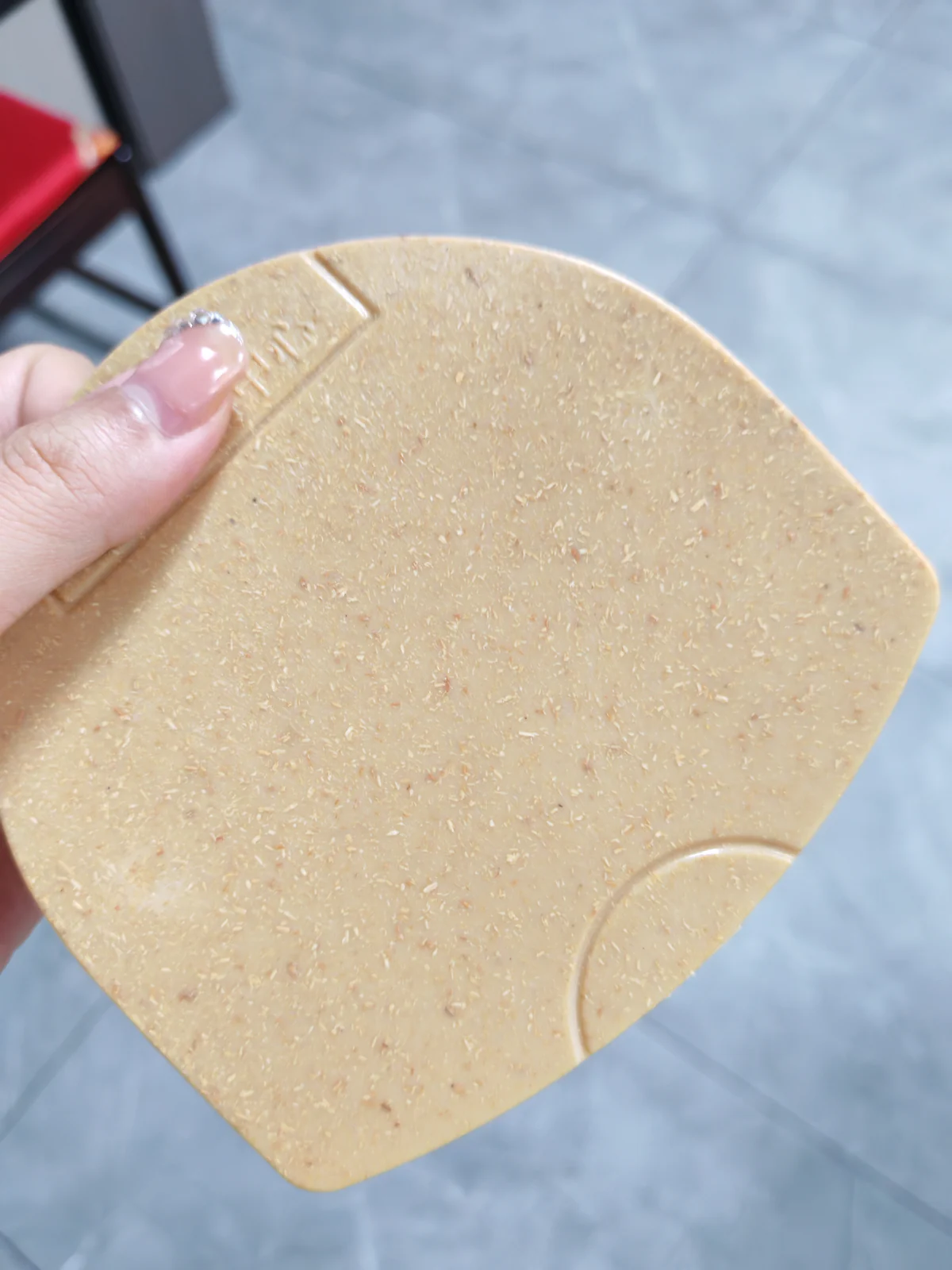
Surface texture is the second balance. Ordinary high-gloss PP can feel slippery between the teeth. P179302 forms a fine, irregular wood-fiber texture that improves grip and gives the dog more tactile feedback. The texture should remain fine and integrated into the matrix; exposed fibers, sharp flash or loose fragments are unacceptable and must be controlled through tooling, process and finishing.
Aroma is the third balance. The natural pine note is intentionally mild. High melt temperature or excessive residence time converts that note into a scorched odor and indicates thermal damage to the fiber. Odor therefore becomes a useful process-control signal as well as a product characteristic.
2. Project One: Converting a Hard PP Chew Stick to P179302
The first customer produced rigid chew sticks from a high-hardness conventional PP. The molded hardness appeared acceptable, but use trials revealed three problems. The glossy surface gave the dog little grip, the conventional plastic odor reduced initial interest and the part occasionally broke through the middle after being thrown or dropped onto a hard floor.
The First Trial Used Too Much Heat
The original PP process used 80°C drying for two hours, barrel zones from 200°C to 210°C, a 210°C nozzle, 50°C mold temperature and high injection speed. Applying that window directly to P179302 produced a dark surface, isolated black specks and a scorched odor. Inspection after the trial also found carbonized residue in the front barrel.
The cause was the processing mismatch. The PP carrier can tolerate the original settings, but the pine fiber cannot remain at that temperature for the same residence time. The team reset the process around the P179302 window: dehumidified drying at 105°C for 4.5 hours, rear zone at 170°C, middle zone at 172°C, front zone at 180°C, nozzle at 180°C and mold at 78°C. Screw speed was reduced to approximately 75% of the original PP setting, injection began at medium speed, back pressure was kept moderate and holding pressure was increased cautiously.
| Control | Original Hard-PP Process | P179302 Trial Direction |
|---|---|---|
| Drying | 80°C / 2 h | 105°C / 4.5 h, dehumidified |
| Rear zone | 200°C | 170°C |
| Middle zone | 205°C | 172°C |
| Front zone | 210°C | 180°C |
| Nozzle | 210°C | 180°C |
| Mold | 50°C | 78°C, later 80°C |
| Screw speed | Standard PP setting | Approximately 75%, then reduced slightly |
| Injection | High speed | Medium-speed starting point |
| Holding | Standard PP setting | Pressure and time raised to control sink |
After the temperature reset, the black specks disappeared, the scorched odor was eliminated and the mild pine note returned. Two issues remained: shallow sink marks at the ends of the chew stick and localized shade variation through the central section.
Two Rounds of Sink and Fiber-Distribution Tuning
The sink marks were located near the far ends of the flow path. Packing ended too early as the relatively cool tool froze the outer skin, limiting compensation for volumetric shrinkage. Raising the mold from 78°C to 80°C, increasing holding pressure by 10% and extending holding time by two seconds removed the visible sink without adding unnecessary melt temperature.
The shade variation came from inconsistent fiber distribution. With an MFR of 7 g/10 min, P179302 does not behave like a high-flow injection PP. Raising screw speed to force output would increase shear and fiber damage. Instead, the team reduced screw speed by another 5% and adjusted back pressure in small steps until the melt became more uniform. The final plaques and chew sticks showed even natural color when viewed against backlighting.
Chew Observation and Drop Testing
Three validation batches were molded. In supervised customer observations with dogs of several sizes, the fine wood-fiber texture provided more grip than the glossy PP version. The mild pine note did not create the same initial avoidance seen with the original plastic odor, and the reported active chew period was approximately three times longer than for the customer’s previous design.
For impact screening, finished sticks were dropped freely from 1.5 meters onto tile. The original PP version fractured in three to four pieces out of every ten tested. Across two P179302 batches totaling 50 parts, no complete fracture occurred under the same project procedure.
Production yield increased from approximately 83% to 96%. The customer adopted P179302 for two rigid chew-stick and chew-bone families while retaining TPE for soft interactive toys. This separated the product line by bite response instead of trying to force one material into every use condition.
3. Project Two: Outdoor Pet Toys with Rope Holes
The second customer made outdoor sound balls, flying discs and rope toys from ordinary PP with color masterbatch. The original design showed three recurring problems: visible whitening and color drift after outdoor use, a sharp high-frequency plastic squeak during biting, and cracks that began at the rope-hole edge during pulling.
Resetting the Temperature and Moisture Window
The previous process used 70°C drying for two hours, a 200°C melt setting and a 45°C mold. P179302 required a substantially different window. The team used a dehumidifying dryer at 105°C for five hours, then set the rear zone to 168°C, middle zone to 172°C, front zone to 180°C, nozzle to 178°C and mold to 75°C. Screw speed was reduced to about 75% of the former PP setting and injection began at medium speed.
The first corrected trial produced the intended natural wood-fiber surface without the glossy plastic feel. Moisture-related silver streaks and bubbles were eliminated. A flow mark and fracture path still remained around the rope hole, showing that the next limitation was part and mold design rather than bulk material strength.
The Rope Hole Needed a Geometry and Gate Change
A rope hole is a strong stress concentrator. The original local wall was only 1.8 mm and the gate was positioned far from the hole. Two flow fronts met around the opening after losing temperature and pressure, creating a weld line exactly where tug loading was highest.
The wall around the hole was increased from 1.8 mm to 2.2 mm and the transition was given a smoother radius. The gate was moved toward the rope-hole region so that the primary flow direction passed through the critical zone with less opposing-flow convergence. Holding pressure was raised and mold temperature was stabilized at 75°C.
After these changes, the visible flow mark disappeared and the project pull result increased from about 120 N to 210 N. The improvement came from the complete system—material stiffness, local section, weld-line control and packing—not from one headline property in the data table.
Outdoor Appearance and Bite Sound
For the customer’s defined 30-day outdoor exposure procedure, the approved natural-color P179302 part maintained a color difference of ΔE ≤ 2.0. Outdoor performance must still be validated against the intended geography, UV dose, temperature, moisture and service life; the useful result here is that the final material-and-color package met this project’s acceptance limit.
The bite sound also changed. Smooth, rigid PP surfaces can generate a sharp squeak as two areas rub or flex against each other. The fiber-filled surface and higher damping of the P179302 part produced a lower, more muted sound in this geometry. In supervised observations, dogs that had reacted to the original high-frequency squeak continued interacting with the revised parts.
Production yield rose from approximately 85% to 95%. The customer extended the material to three outdoor families: sound balls, flying discs and rope-knot toys. Each geometry retained its own validation limits because a successful flying-disc section does not automatically approve a thick chew component or a rope-hole design.
4. Practical Process Window and Troubleshooting
The two projects produced a consistent process strategy for P179302. These values are starting references for trial molding; the final window must reflect shot size, residence time, runner, gate, wall thickness, venting and the real part.
| Stage | Recommended Starting Range | Production Focus |
|---|---|---|
| Drying | 100–110°C / 4–5 h | Use sealed dehumidifying equipment and prevent reabsorption |
| Rear barrel | 165–175°C | Keep feed-zone heat conservative |
| Middle barrel | 165–175°C | Build a uniform melt without excessive shear |
| Front barrel | 175–185°C | Increase only as filling requires |
| Nozzle | 175–185°C | Avoid drool and long hot residence |
| Mold | 70–80°C | Stabilize surface, weld lines and packing |
| Screw speed | Medium-low | Limit fiber damage and uncontrolled heat |
| Back pressure | Moderate | Balance dispersion against shear |
| Injection speed | Medium starting point | Adjust for gate, flow length and weld lines |
| Holding | Part-specific | Tune pressure and time against sink and dimensions |
Temperature Is the First Red Line
Do not copy a 200–210°C conventional PP process into P179302. Excessive melt temperature or residence time scorches the wood fiber, producing black specks, darkening, gas, odor and irreversible loss of performance. Begin near the lower end of each zone and add only the heat needed for stable filling.
Dry with Dehumidified Air
Wood fiber is moisture-sensitive. Incomplete drying produces bubbles, silver streaks, rough surfaces and inconsistent strength. Use 100–110°C for four to five hours as the starting window, keep the hopper and transfer path closed and confirm dryer condition during humid weather. A hot-air hopper that continually draws humid plant air may warm the pellets without creating a stable moisture condition.
Do Not Trade Fiber Integrity for Apparent Flow
The MFR is 7 g/10 min, so flow is lower than many commodity injection PP grades. Compensating with excessive screw speed and shear shortens fibers, raises melt temperature and can worsen surface variation. Use medium-low screw speed, moderate back pressure and part-specific packing. If the part short-shots, review drying, shot size, gate, venting and pure-PP blending options before simply raising barrel temperature.
Use Corrosion-Resistant Tooling and Clean Promptly
Use hardened, corrosion-resistant mold steel for regular production. Plant-fiber residue left in tooling can retain moisture and accelerate corrosion or surface damage. Purge the barrel with PP after production, clean vents and critical mold surfaces promptly and avoid leaving the compound stationary in a hot barrel during extended stops.
Design Rope Holes and Other Stress Concentrations Deliberately
Material strength cannot compensate for a sharp corner, thin local wall or weld line placed directly in the pull path. The outdoor-toy project succeeded at a 2.2 mm rope-hole wall with a smoother transition and revised gate, but that value is a project example rather than a universal minimum. Use flow analysis, molded pull tests and repeated environmental conditioning for the real geometry.
Control Regrind and Batch Appearance
Repeated heat history deepens color and odor and changes fiber length. Keep regrind at or below 10% during the initial production window unless a structured trial supports another limit. Record the resin lot, regrind ratio, dryer condition, cycle settings and retained color standard so natural feedstock variation can be separated from process drift.
Common Defects
| Defect | Likely Cause | First Checks |
|---|---|---|
| Black specks or burnt odor | Excessive temperature, residence time or contaminated barrel | Return to the grade window, shorten residence and purge thoroughly |
| Silver streaks or bubbles | Moisture or reabsorption after drying | Check dryer dew point, hopper sealing and material transfer |
| Sink marks | Insufficient packing, early gate freeze or thick local section | Review mold temperature, gate seal, hold pressure and hold time |
| Uneven fiber tone | Unstable shear, poor mixing, high regrind or lot variation | Stabilize screw speed, back pressure, dosing and retained samples |
| Short shot | Low flow, inadequate venting, small gate or insufficient pressure | Review gate/vent design and pressure before adding excessive heat |
| Rope-hole cracking | Thin wall, sharp radius, weld line or poor packing | Add section and radius, revise gate and validate by pull testing |
| Surface scratches from tooling | Residue, corrosion or damaged mold finish | Clean promptly and use hardened corrosion-resistant steel |
| Odor or color drift between batches | Regrind variation, heat history or unstable natural feedstock | Control regrind, residence time, lot records and approval standard |
5. Where P179302 Fits in the wooyopet Plant-Fiber PP Range
P179302 is the wood-fiber route for pet products that need high stiffness, bite-resistant geometry, visible natural texture and a mild pine identity. Among the four referenced wooyopet routes below, it has the highest flexural modulus. It is best suited to medium-wall structural and appearance parts rather than very thin sections that depend on high flow.
| Grade | Material Direction | MFR | Tensile Strength | Flexural Modulus | Notched Impact | Typical Selection Logic |
|---|---|---|---|---|---|---|
| WYC-PP P179302 | Wood-fiber PP compound | 7 g/10 min | 32 MPa | 2,210 MPa | 4.5 kJ/m² | Firm chew sticks, pet-toy structures and natural-texture parts |
| WYC-PP P179002N | Fine grain-fiber PP | 9.5 g/10 min | 31 MPa | 1,956 MPa | 3.8 kJ/m² | Light-color food-contact containers and cleaner fine-fiber appearance |
| WYC-PP P179050 | Wheat-straw PP | 15 g/10 min | 18 MPa | 2,000 MPa | 3.1 kJ/m² | Higher-flow parts where coarse fiber points are acceptable |
| WYC-PP P179-CZML | Tea-fiber PP masterbatch | 7 g/10 min | 27 MPa | 1,337 MPa | 5 kJ/m² | Tea-tone appearance and aroma adjusted through a final PP let-down formulation |
For a food or water bowl that prioritizes a light, uniform appearance and food-contact documentation, P179002N may provide a more direct route. For a thin-wall component that prioritizes flow over surface uniformity and tensile strength, P179050 may be easier to fill. P179-CZML serves a different purpose: it is a concentrated masterbatch for creating a tea-fiber appearance and must be evaluated in its final PP blend.
P179302 occupies a clear position: the combination of 2,210 MPa flexural modulus, 4.5 kJ/m² notched impact performance, 73 HD hardness, a fine wood-fiber surface and a mild pine note supports pet chew and outdoor-toy concepts that ordinary PP and soft TPE do not address in the same way.
Conclusion
Developing a wood-fiber pet product is not a matter of replacing ordinary PP pellet-for-pellet. The compound, product geometry, mold, drying system and processing window must be designed together. The chew-stick case showed how lower melt heat, warmer tooling and controlled shear eliminated scorching, sink and fiber variation. The outdoor-toy case showed that a rope-hole failure required a wall, radius and gate correction rather than a simple material change.
wooyopet WYC-PP P179302 provides a high-stiffness, natural-texture PP route for chew sticks, chew bones, outdoor balls, flying discs and rope toys. Product teams can use the processing windows and defect table above as a starting point, then validate the final design through dimensional, impact, pull, fragment-retention, environmental and supervised use testing.
For a P179302 sample, molded color reference, process recommendation or part review, share the product drawing, wall thickness, gate position, target dog size, expected use environment and current PP process with wooyopet.